
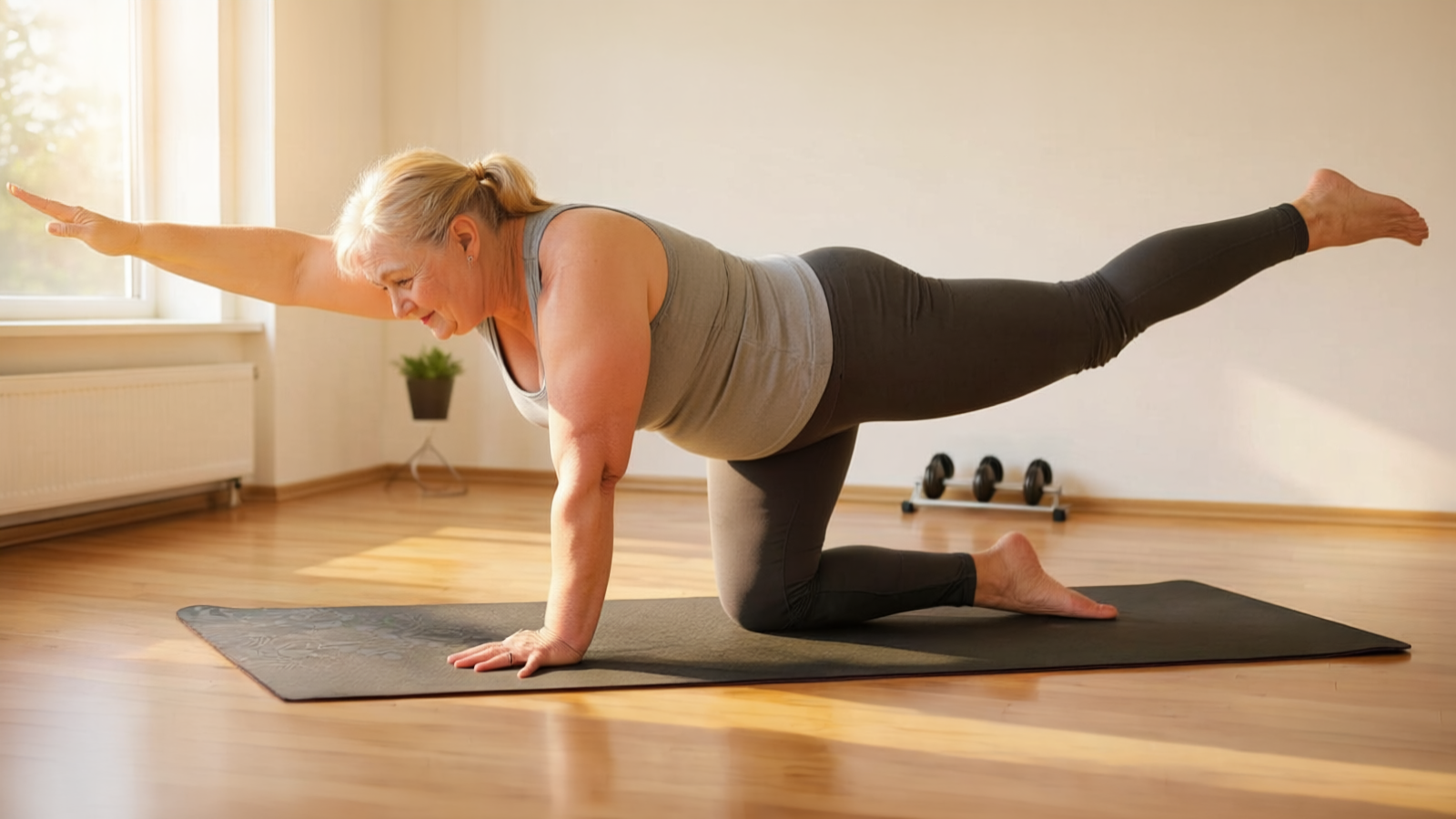
This beginner workout for women over 40 is a 4-week bodyweight plan with three full-body strength sessions per week. Each session includes five exercises: fire hydrant, bird dog, glute bridge, wall push-up, and hands-behind-head squat. Sets and reps increase each week. No equipment required.
By Deb Simpson, NASM Certified Personal Trainer — Deb coaches women over 40 who are building strength from the ground up.
- Why This Plan Is Built the Way It Is
- Your Free 4-Week Beginner Workout Plan
- Recommended Equipment to Get Started
- Medical Disclaimer
- Frequently Asked Questions
Somewhere in your 40s, your body starts doing things you didn’t authorize. Muscle that wasn’t doing anything flashy just quietly leaves. Joints get noisy when you take the stairs. Balance, which you assumed was just a thing you had, turns out to be a skill that requires actual practice. And let’s not even talk about the hairs growing in novel places.
Strength training addresses more of this than you’d think. And it doesn’t require a gym, a complicated program, or a personality transplant. The plan is below.
Why This Plan Is Built the Way It Is
Four weeks of bodyweight squats and wall push-ups won’t reverse a decade of not moving — but the goal here isn’t reversal. It’s interruption.
Starting in your 30s, the body loses muscle mass at a rate of roughly 3–8% per decade. After 50, that accelerates. Bone density follows. This is sarcopenia — the technical term for age-related muscle loss — and it doesn’t care whether you’re busy, whether the gym felt intimidating, or whether you fully intended to start last January. It runs on its own schedule regardless. What resistance training does is give your body a reason to slow that schedule down. Consistently loading your muscles signals that they’re still needed, and the body tends to hold onto things it’s still being asked to use. Doing nothing isn’t neutral — it’s just letting yourself age faster than you have to.
So the actual goal of this plan isn’t getting fit — it’s setting up the structure to not lose ground faster than you have to.
Four weeks is enough time for three-days-a-week to stop feeling like something you’re doing and start feeling like something you just do on Mondays, Wednesdays, and Fridays. That’s the whole point of the timeline. The sets and reps increase each week so your body has a reason to keep adapting rather than coasting. Full body every session, no equipment required, so the only logistics problem is finding thirty minutes.
Your Free 4-Week Beginner Workout Plan
Weekly Schedule
3 Days per Week: Full-Body Strength Workouts
2 Optional Days: 30-Minute Active Recovery Walk
2 Complete Rest Days: Allow your body to recover & rebuild
| Day | Type |
|---|---|
| Day 1 | Strength Training |
| Day 2 | Rest or Active Recovery Walk |
| Day 3 | Strength Training |
| Day 4 | Rest |
| Day 5 | Strength Training |
| Day 6 | Rest or Active Recovery Walk |
| Day 7 | Rest |
Warm-Up (5–10 Minutes)
- March in Place — 2 minutes. Lift your knees slightly and swing your arms naturally. Keep a steady pace and breathe.
- Hip Circles — Stand with feet shoulder-width apart, hands on hips. Slowly rotate hips in large circles — forward, to the side, back, and around. Do 8–10 circles in one direction, then reverse.
- Arm Circles — Extend both arms out to your sides. Make slow circles forward for 30 seconds, then reverse.
Rest Between Sets: Rest 60–90 seconds between sets. If you’re ready sooner, 30 seconds is fine — this isn’t a stopwatch requirement, it’s just enough time that the next set doesn’t turn into a fight with your breathing.
The Workout — Progressive 4-Week Plan
Sets and reps increase each week. Days 3 and 5 repeat Day 1’s workout for that week.
| Exercise | Week 1 | Week 2 | Week 3 | Week 4 |
|---|---|---|---|---|
| Fire Hydrant | 2 × 10 per side | 3 × 10 per side | 3 × 12 per side | 3 × 14 per side |
| Bird Dog | 2 × 8 per side | 3 × 8 per side | 3 × 10 per side | 3 × 12 per side |
| Glute Bridge | 2 × 12 | 3 × 12 | 3 × 14 | 3 × 16 |
| Wall Push-up | 2 × 8 | 3 × 8 | 3 × 10 | 3 × 12 |
| Hands-Behind-Head Squat | 2 × 10 | 3 × 10 | 3 × 12 | 3 × 14 |
Rest 60–90 seconds between sets (30 seconds if you’re ready sooner).
Exercise Notes & Modifications
- Fire Hydrant — Target: Glutes, hips, core. On all fours. Lift one leg out to side, knee bent 90 degrees. Keep hips square. Easier: Reduce range of motion. Harder: Pause 3 seconds at top.
- Bird Dog — Target: Core, glutes, lower back, shoulders. On all fours. Extend opposite arm and leg straight. Keep hips level. Easier: Extend arm, hold, return. Then leg separately. Harder: Hold 5 seconds at top.
- Glute Bridge — Target: Glutes, hamstrings, lower back, core. On your back, knees bent, feet flat. Press through heels to lift hips until body forms straight line. Squeeze glutes at top. Easier: Don’t lift as high. Harder: Single-leg bridges.
- Wall Push-up — Target: Chest, shoulders, arms, core. Hands shoulder-width at chest height on wall. Step feet back to form a diagonal line. Lower chest toward wall, elbows at 45 degrees. Easier: Step closer to wall. Harder: Step further from wall.
- Hands-Behind-Head Squat — Target: Quads, hamstrings, glutes, core. Feet shoulder-width apart, hands behind head, elbows wide. Push hips back, lower until thighs parallel to floor. Easier: Use a chair behind you as a target. Harder: Pause 2 seconds at bottom.
Cool-Down (5–10 Minutes)
Hold each stretch for 20–30 seconds. Move slowly and breathe.
- Seated Hamstring Stretch — Sit on floor, both legs extended. Reach toward your feet as far as comfortable. You’ll feel this in the backs of your thighs.
- Wall Chest Stretch — Stand beside a wall, place one palm flat at shoulder height. Keep arm straight, slowly rotate body away from wall until you feel a stretch across your chest. Switch sides.
- Cross-Body Shoulder Stretch — Stand tall, bring one arm straight across your chest. Use your opposite hand to gently hold your upper arm and pull it slightly closer until you feel a stretch in the back of your shoulder. Switch sides.
This plan is also available as a $7 PDF. If you’re new to this and want something you can save to your phone or print out and leave in your workout space, that’s what it’s for. Photos for every movement, complete form cues, and modifications explained with enough detail to know which one applies to you.
Start with week 1 as written. Add reps when the movements feel easy, add sets when the program calls for it. When bodyweight stops being the limiting factor — and it will — that’s when load enters the picture. If you want a structured coaching plan that handles what comes after this — starting weights, progressions, and all of it — that’s what Featherweight Fitness is for. I work with women building strength from the ground up.
Recommended Equipment to Get Started
No equipment needed for this plan. If you want to extend your range once bodyweight gets easy:
- Resistance Bands — Joint-friendly and great for adding resistance to strength training.
- Dumbbells (5–15 lbs) — Builds strength gradually once bodyweight becomes easy.
- Balance Disk — Improves stability and core engagement, great for the balance hold exercise.
- Yoga Mat — Adds comfort and support during floor exercises like glute bridges.
- Foam Roller — Aids muscle recovery and reduces soreness on rest days.
Need recommendations? Check out my home gym equipment guide.
Medical Disclaimer
Before beginning any new fitness program, especially if you have existing health conditions, please consult with a healthcare professional. This guide is for educational purposes only and is not a substitute for medical advice.
Frequently Asked Questions
Can women over 40 build muscle?
Yes. Muscle loss accelerates with age, but resistance training gives the body a direct reason to slow that process and, in many cases, reverse it. The goal is to stay functional, maintain bone density, and age slower than you otherwise would.
How many days a week should a woman over 40 work out?
Three days a week is the right starting point for a beginner. It’s enough to build the stimulus for adaptation without accumulating so much fatigue you can’t recover between sessions. Recovery is where adaptation actually happens — the workout is the trigger. Rest days aren’t optional. They’re part of the program.
Do I need equipment to start strength training?
No. Bodyweight is enough for the first several weeks while you’re building movement patterns and the habit of showing up. The five exercises in this plan — fire hydrant, bird dog, glute bridge, wall push-up, and hands-behind-head squat — require nothing but floor space and a wall. Load comes later, when bodyweight stops being the limiting factor.
How long does it take to see results from strength training?
Depends on what you mean by results. Coordination and movement patterns improve in the first two to four weeks — you’ll feel the exercises working faster than you expect. Visible muscle changes take longer, typically eight to twelve weeks of consistent training. Functional improvements — things like getting up off the floor without the internal monologue about how this didn’t used to be this hard — often show up in the first month.
Is it safe to start strength training after 40 without a trainer?
A structured plan with clear progression is safe for most beginners. The risk with no guidance isn’t the movements themselves — bodyweight squats and wall push-ups have a low injury threshold. The risk is form patterns that develop quietly and cause problems later. The modifications in this plan and the form cues in the PDF exist specifically to prevent that. If you have a preexisting injury or medical condition, check with your doctor before starting.
What is sarcopenia?
Sarcopenia is the age-related loss of muscle mass. It starts in your 30s at a rate of roughly 3–8% per decade and accelerates after 50. It isn’t a fitness failure — it’s biology running on its own schedule regardless of what you do. What resistance training does is interrupt that schedule. Consistently loading your muscles signals that they’re still needed, and the body tends to hold onto things it’s still being asked to use.
Keep Exploring
- Beginner Strength Training for Women: The Complete Guide
- Best Yoga Mats for Beginners — Floor exercises are easier with something between you and the ground.
- Best Foam Rollers for Beginners — What to buy for recovery and how to use it.