
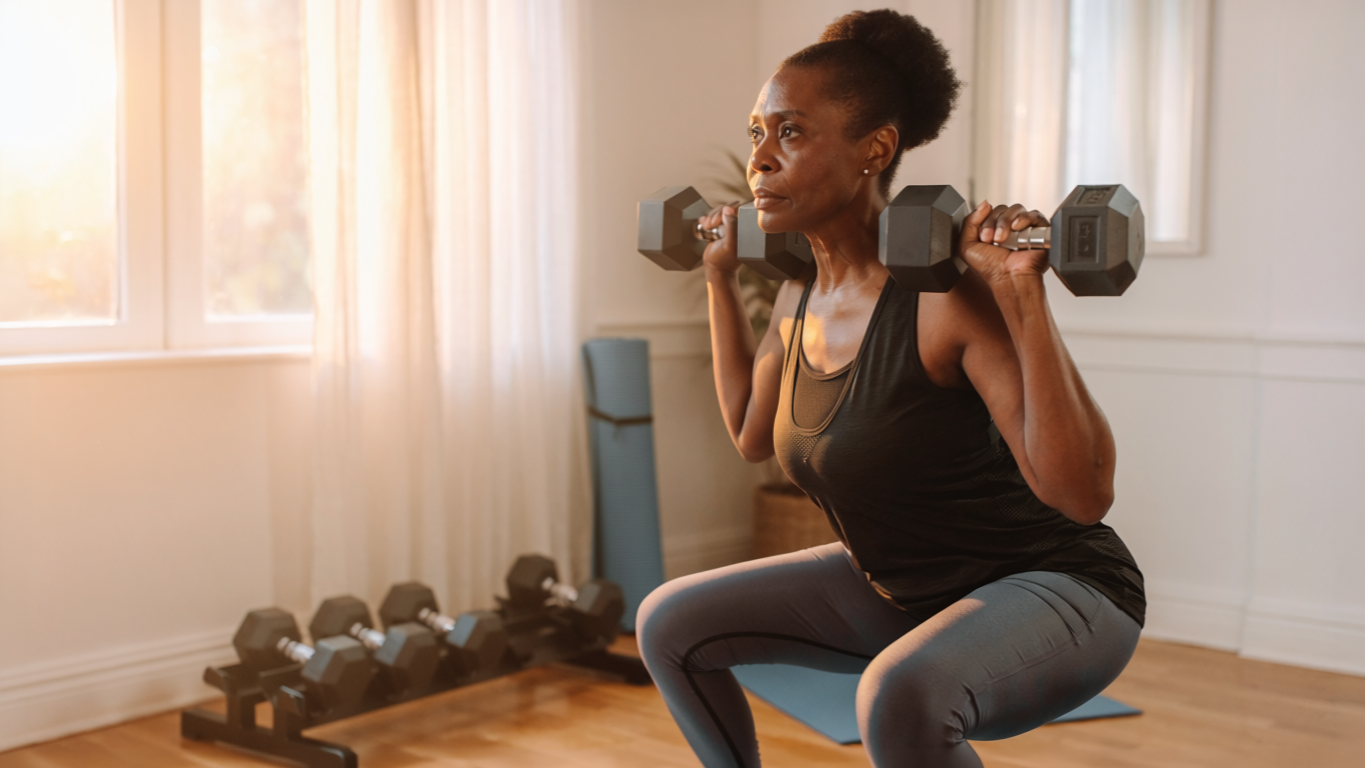
Beginner strength training for women means three full-body sessions per week, built around six movement patterns: push, pull, squat, hinge, carry, and balance. Start with 2 to 3 sets of 10 reps per exercise, resting 45 to 90 seconds between sets. Add weight or reps once the current sets stop feeling hard.
By Deb Simpson, NASM Certified Personal Trainer — Deb coaches women over 40 who are building strength from the ground up.
- What Is Strength Training — and Why Women Over 40 Need It More Than They’ve Been Told
- How to Structure Your Workouts
- Choose Your Training Space
- Find Your Time
- The Six Movement Patterns
- Sets, Reps, Rest — and How Much Weight to Use
- Building Accountability
- Track Progress — Including What the Scale Won’t Show You
- Set a Goal That’s Actually Measurable
- What’s Next
- Frequently Asked Questions
Somewhere after 40, normal things start requiring a recovery period. Bending down to pick something up. Sleeping wrong. Breathing. Strength training fixes a surprising amount of this — not because it’s magic, but because most of the problem is muscle groups that have been completely offline for years. Wake them up, build some load tolerance, and the absurdity of being wrecked by a nap goes down considerably.
What Is Strength Training — and Why Women Over 40 Need It More Than They’ve Been Told
Humans like to complicate the simple. And strength training is simple.
You lift heavy things repeatedly. Your body gets the message: we need more muscle to handle this. So it builds some. You then lift heavier things — or do more reps, or more sets, or rest less — and send the same message again. Your body keeps building.
The technical term for “keep making it harder so your body keeps adapting” is progressive overload. There are a lot of ways to do it: add weight, add reps, add sets, shorten rest periods, slow the movement down so your muscles are working longer. They all do the same simple thing — you’re telling your body keep up over here, and your body does.
Now here’s the part that doesn’t get talked about enough.
Men and women build muscle the same way, but we’re not working with the same hormonal setup. Men’s primary sex hormone is testosterone, which is aggressively anabolic — meaning it directly drives protein synthesis and muscle growth. Women’s primary sex hormone is estrogen, which also has anabolic effects: it helps build and preserve muscle tissue, regulate muscle function, and support recovery. But women have about one-tenth the testosterone men do. We can absolutely build muscle — research shows women get the same relative gains from strength training as men — but our hormonal advantage is smaller and more fragile.
And after 40, it gets smaller. Estrogen starts declining in perimenopause, and according to research on the musculoskeletal effects of menopause, that decline has measurable consequences: women lose an average of 10% of their bone mineral density during the perimenopausal transition. Once menopause hits, bone density drops 1–2% per year for the first five years — sometimes as high as 3–5%. Muscle mass follows at about 0.6% per year after menopause. More than 70% of women experience musculoskeletal symptoms through this transition. A quarter are disabled by them.
Strength training directly counters this decline. It signals the body to maintain muscle. It puts mechanical load on bone, which slows density loss. Your doctor might be telling you to lose weight. Your knees might be filing complaints. A stronger body addresses more of both than most people expect — it moves differently, burns more at rest, and holds itself together better.
How to Structure Your Workouts
There are a lot of ways to build a strength training program — which is part of why this space can feel overwhelming. Equipment choices, exercise selection, sets, reps, rest times, time under tension — there’s an entire industry built around these variables, and a lot of it is designed to sound more complicated than it is. Most women who try to get started hit this wall. They look for a program, end up with seventeen conflicting opinions about what’s optimal, and walk away convinced that strength training requires expertise they don’t have.
It doesn’t. Just about any program — whether it’s one you found online, one you paid hundreds of dollars for a personal trainer to administer, or one you home-brewed with ChatGPT — works, as long as the exercises are done safely, you practice progressive overload, and you show up consistently.
For a beginner, the simplest structure is a full-body workout three times a week. You train your legs, chest, back, shoulders, and core in one session, rest, then come back in two days and do it again. Every muscle group gets worked consistently, the schedule is manageable, and missing one session doesn’t leave anything sitting idle for a week.
Three full-body sessions a week is the entire job right now. Simple.
Eventually some people move to a training split — upper body one day, lower body the next, push-pull-legs, or one muscle group per day. A split makes sense when your base is built enough that one full-body session can’t cover enough volume for each muscle group to keep progressing. File that away for later.
If you’d rather have someone else handle the programming while you focus on showing up, that’s what Featherweight Fitness is for. I work with women building strength from the ground up — schedule, structure, and starting point included
Choose Your Training Space
Before you pick a program or buy a single piece of equipment, decide where you’re training. The answer shapes everything — what equipment you need, what movements are available to you, and what your sessions actually look like. A program built around a cable machine doesn’t help if you’re working out in your living room.
Strength training at home and at a gym both work. The question is which one you’ll actually show up to consistently.
There’s something worth knowing about working out at home that fitness content rarely says directly: for a lot of women, home is where the work never stops — the laundry, the cooking, the second shift that starts when the first one ends. However, working out at home has its benefits: no commute, no audience (except the dog), no ongoing cost once you have the basics. The downside is that the couch is right there, and so is everything else that needs doing.
The gym is somewhere that is not home and not work — a neutral space where for an hour the only demands on you are physical and entirely yours. That separation is worth something. It’s one reason some people train better there even when home would be more convenient. The downsides are real: commute, cost, crowds, and the reasonable discomfort of learning a new culture in a space where everyone else already looks like they know what they’re doing.
Pick the one you’ll actually show up to consistently — then treat it exactly like your kid’s Tuesday swim practice. It’s on the calendar. You’re going to be there.
Find Your Time
The most common obstacle isn’t motivation. It’s that the calendar is already full — and it’s mostly full of other people’s needs.
Habit stacking is one of those things that helps when you’re still building the schedule. Attach the workout to something that already happens: first thing in the morning, right after the kids leave for school, during the lunch hour that you’ve been casually donating to email. The workout borrows structure from an existing routine instead of requiring you to build new structure from scratch.
I can confirm via life experience two things that consistently don’t work: waiting for “when things calm down” (ma’am, I can assure you, they will not), and leaving the schedule open-ended. Pick the days. Pick the time. Put it in the family calendar. In my experience, when you stop treating your training time as optional, everyone else does too.
If you’re looking for ways to add more movement without adding more scheduled sessions, a walking pad in front of the TV is worth considering. It converts time you’re already spending — winding down at the end of the day, watching something, catching up on a show — into easy low-intensity movement. Works whether you train at home or at a gym. If you’re shopping for one, the walking pad buying guide covers what to look for.
The Six Movement Patterns
You’ll run across six types of movements in most beginner strength programs. A full-body session can cover all six in one go, which is one of the reasons starting there makes sense. Some of these movements require equipment beyond your own bodyweight — if you’re building out a home setup or figuring out what you actually need, the equipment guide covers it. Skip any one of these patterns consistently and gaps develop — usually discovered when something starts hurting.
Push: Pressing something away from you. Works your chest, shoulders, and the backs of your arms. The most familiar version: a push-up. You can do these from the wall (easiest), from an incline with your hands on a bench or step, or from the floor when you’re ready.
Pull: Pulling something toward you. Works your back and biceps. Think about the muscles you use when you haul a heavy door open toward you — that’s the same motion as a row, and it’s one of the most useful things you can train.
Squat: Bending at both hips and knees to lower down, then pressing back up. Think sitting into a chair and standing back up with intention. Works your quads, glutes, and hamstrings. Start with bodyweight. Add a weight held at your chest when that gets easy.
Hinge: Hips go back, knees stay mostly straight — like closing a cabinet door with your rear end. Works your hamstrings, glutes, and lower back. The deadlift is a hinge. So is picking something up off the floor with good form, which most people stopped doing at some point and are paying for now.
Carry: Pick something heavy up and walk with it. Works your grip, your core, and every stabilizing muscle that doesn’t get targeted by the other five. One dumbbell at your side or two. Walk across the room. Set them down. That’s it.
Balance: Stand on one foot and see how long you last. That’s your baseline. Step-ups onto a stair or box build from there — step up with one leg, drive through that heel to stand, step back down. Ten times on each side. Harder than it looks, which tells you exactly where you’re starting.
Sets, Reps, Rest — and How Much Weight to Use
Now you know what movements you’re doing. The next question every beginner runs into is: how many, how heavy, and how long do I rest between?
Start with 2–3 sets of 10 reps per movement. Rest 45–90 seconds between sets.
Picking the right weight is where most beginners stall before they even start. Too light and nothing changes. Too heavy and form breaks down. The rule of thumb: the last 2–3 reps of each set should feel hard, but you should be able to complete them with decent form. If you could keep going past 12 without much effort, it’s too light. If you can’t get through 8, decrease the weight. For specific starting points by exercise, the guide to choosing your dumbbell weight walks through it in detail.
When 10 reps starts feeling manageable, do 12. When 12 feels manageable, add a small amount of weight and drop back to 10. That’s the progression. Small, boring, reliable. Simple.
Rest matters more than most people think. 2–3 minutes between sets if you’re lifting heavy for fewer reps. 45–90 seconds for moderate sets of 10–15. Cutting rest short to feel like you’re working harder mostly just makes the next set worse.
Building Accountability
That’s the mechanics. The part that determines whether any of it actually works is simpler and harder than exercise science: you have to keep showing up.
Showing up when work is bad, the kids are gremlins, and the couch has been making its case since 3pm requires more than good intentions.
A workout partner helps — not because you need to train together, but because checking in after sessions adds a small external layer of accountability. Even a text counts.
For tracking, I’ve tried most of the apps. One thing has actually worked over the years: a plain Excel spreadsheet — date, exercise, weight, sets, reps. Low friction, easy to maintain, and the data is there when you need it. The log shows you when you’ve stalled, when you’ve made progress you hadn’t noticed, and when it’s time to add weight. Written evidence beats memory every time.
If you’d rather have someone else handle the programming while you focus on showing up and doing the real work, that’s what Featherweight Fitness is for. I work with women building strength from the ground up — schedule, equipment, and starting point included.
Track Progress — Including What the Scale Won’t Show You
There’s a non-zero chance your doctor has told you to lose weight. A lot of women start strength training with the scale as the primary scoreboard, because that’s the number they’ve been told to move.
Here’s the problem: the number on the scale on a single day, or even over a week’s time, is a poor measurement tool for what’s actually happening when you strength train. Muscle is denser than fat — you can be losing fat and building muscle simultaneously and see almost no change in the number, or even see it tick up slightly. Hormones, hydration, sodium intake, and time of day all affect the reading. It measures one thing: total body weight at one moment. Not what that weight is made of, how your body is moving, or whether anything is actually improving.
This doesn’t mean weight loss isn’t a valid goal, and it doesn’t mean the scale isn’t useful. It means context matters. Twenty pounds creeps on incrementally — one day you wake up and it’s just there. Losing it takes sustained effort, but not more time than the gain took for most people. Where the scale earns its place is over a longer timeline: tracking the trend over one to three months lets you ignore the daily noise and look at the actual direction. As a daily scoreboard for strength training progress, it’s the wrong tool. As a monthly trend line, it tells you something real.
Better short-term markers:
Strength: Are you lifting more weight than last month? Completing more reps with the same weight? Your training log shows this clearly — which is one more reason to keep one.
Energy: Less afternoon crash. More capacity during the sessions themselves. This shows up before visible physical changes do.
Daily life: Getting off the floor without a seven-point plan. Carrying all the groceries from the car in one trip. Going up stairs without your knees filing a complaint. These don’t appear in any app, but they’re the actual return on investment.
Sleep: Strength training improves sleep quality for most people. Better sleep improves recovery. The two reinforce each other.
Consistency: Are you hitting three sessions a week? The pattern is the progress.
Progress isn’t linear. There will be weeks that feel like regression. That’s normal physiology, not failure.
Set a Goal That’s Actually Measurable
The progress markers above work better when you have a specific target to measure against. Which means this is a good moment to set one.
SMART goals: Specific, Measurable, Achievable, Relevant, Time-bound.
Vague: “I want to get stronger.”
SMART: “I will complete three full-body strength sessions per week for the next four weeks.”
For a beginner, the primary goal is attendance. Strength follows attendance. Once consistency is established — meaning you’re actually hitting three sessions most weeks — the goals evolve into weight targets, rep milestones, and specific movement benchmarks.
Goals that work:
- Complete 3 sessions per week for 4 weeks
- Add 5 lbs to my squat by week 8
- Do one full push-up from the floor by the end of the program
Goals that don’t:
- “Lose 15 pounds” — too many variables outside training alone
- “Get toned” — not measurable
- “Work out every day” — not appropriate for strength beginners, and your muscles would probably want to speak with a manager about recovery
What’s Next
The free Beginner Workout Plan for Women Over 40 has four weeks of workouts already mapped — exercises, sets, reps, and progressions — so you don’t have to figure out the structure yourself. Download it and start there.
When the four weeks are done and bodyweight stops being the limiting factor, What to Do After Beginner Strength Training covers exactly what comes next: when to add load, how to progress, and what a more advanced program actually looks like.
Start with the basics. Track your reps. Add weight when the sets stop feeling hard. If you want a structured coaching plan that handles the programming — exercise selection, progressions, starting weights, form coaching — all the confusing bits — that’s what Featherweight Fitness is for. I work with women building strength from the ground up.
Frequently Asked Questions
What is strength training?
Strength training means working your muscles against resistance — weights, bands, or your own bodyweight — and progressively increasing that resistance over time. The result is stronger muscles, stronger connective tissue, better bone density, and improved metabolism. The mechanism is simple: lift something heavy enough that it’s hard, rest, then do it again. Your body adapts by building more muscle. That’s progressive overload, and it’s the entire system.
How many days a week should a beginner do strength training?
Three days a week is the standard starting point for beginners. This gives each muscle group enough work to adapt and enough recovery time between sessions. Full-body workouts three times a week — Monday, Wednesday, Friday or a similar pattern — hit every muscle group consistently without overloading a schedule that’s already full.
Why is strength training especially important for women over 40?
Women’s primary sex hormone is estrogen, which has anabolic effects — it helps build and preserve muscle tissue and supports bone density. Starting in perimenopause, estrogen declines. Research shows women lose an average of 10% of bone mineral density during the perimenopausal transition, and bone density can drop 1–2% per year once menopause hits. Muscle mass follows at about 0.6% per year after menopause. Strength training directly counters both — it signals the body to maintain muscle and puts mechanical load on bone, which slows density loss.
What is progressive overload and why does it matter?
Progressive overload means consistently making your workouts harder so your body keeps adapting. There are several ways to do it: add weight, add reps, add sets, shorten rest periods, or slow the movement down so muscles are working longer. They all accomplish the same thing — you’re telling your body it needs to build more muscle to keep up. Without progressive overload, the body has no reason to keep adapting, and progress stalls.
What’s the difference between a full-body workout and a training split?
A full-body workout trains your legs, chest, back, shoulders, and core in one session. You do this 3 times a week. A training split divides muscle groups across different days — upper body one day, lower body another, or push-pull-legs across multiple days. Splits require more days in the gym and more complexity. For beginners, full-body workouts are the right starting point. Splits make sense later, when the base is built enough that one full-body session can’t cover enough volume for each muscle group.
What are the six movement patterns in strength training?
A well-rounded beginner program covers six movement patterns: Push (pressing something away from you — push-ups, chest press), Pull (pulling something toward you — rows, lat pulldowns), Squat (bending at hips and knees to lower and stand — goblet squat, bodyweight squat), Hinge (hips go back with knees mostly straight — deadlift, Romanian deadlift), Carry (picking something heavy up and walking with it — farmer’s carry), and Balance (single-leg work — step-ups, single-leg deadlifts). Covering all six across the week ensures no major muscle group is neglected.
How do I know what weight to start with?
The last 2–3 reps of each set should feel hard, but you should be able to complete them with decent form. If you could keep going past 12 reps without much effort, the weight is too light. If you can’t get through 8 reps, decrease the weight. Start lighter than you think you need to and increase from there. The specific starting weight varies by exercise — a guide to choosing dumbbell weight by exercise gives concrete starting points.
How long should a beginner strength training session take?
Beginner strength sessions run 20–45 minutes including warm-up and cool-down. Three sessions a week is 60–135 minutes of total training time. Sessions don’t need to be long to be effective — the quality of effort and consistency of showing up matter far more than session duration.
Should I train at home or at a gym?
Both work. The right choice is whichever one you’ll actually show up to consistently. Training at home means no commute, no cost beyond equipment, and no audience. A gym provides more equipment and a dedicated space away from home and work demands — some people train better in that neutral environment. Decide where you’ll train before choosing a program, since the answer determines what equipment you have access to.
How do I track strength training progress if I don’t want to use the scale?
Better short-term markers than the scale include: strength gains (lifting more weight or completing more reps than last month), energy levels (less afternoon crash, more capacity in sessions), daily life improvements (getting off the floor more easily, carrying groceries without effort, climbing stairs without knee complaints), sleep quality, and consistency (how often you’re hitting your three weekly sessions). Keep a training log — it shows progress you’d otherwise miss.
Is the scale useful at all when strength training?
Yes, but only over a longer timeline. Muscle is denser than fat — you can be losing fat and building muscle simultaneously and see almost no change in the scale, or even see it tick up slightly. As a daily scoreboard, it’s the wrong tool. As a monthly trend line tracked over one to three months, it tells you something real about the direction your body composition is moving.
What should I do after finishing a beginner strength program?
When bodyweight stops being the limiting factor — meaning the exercises feel too easy even at higher reps — it’s time to add load. The next step involves introducing dumbbells or other resistance, increasing volume, and potentially moving to a training split. The goal is to keep sending the progressive overload signal: more weight, more reps, or more sets than last time. What to Do After Beginner Strength Training covers exactly what comes next.
Keep Exploring
- Beginner Workout Plan for Women Over 40 — four weeks of structured workouts, no equipment required
- How to Choose Your Dumbbell Weight — starting points by exercise so you don’t guess
- What to Do After Beginner Strength Training — when this program has done its job