
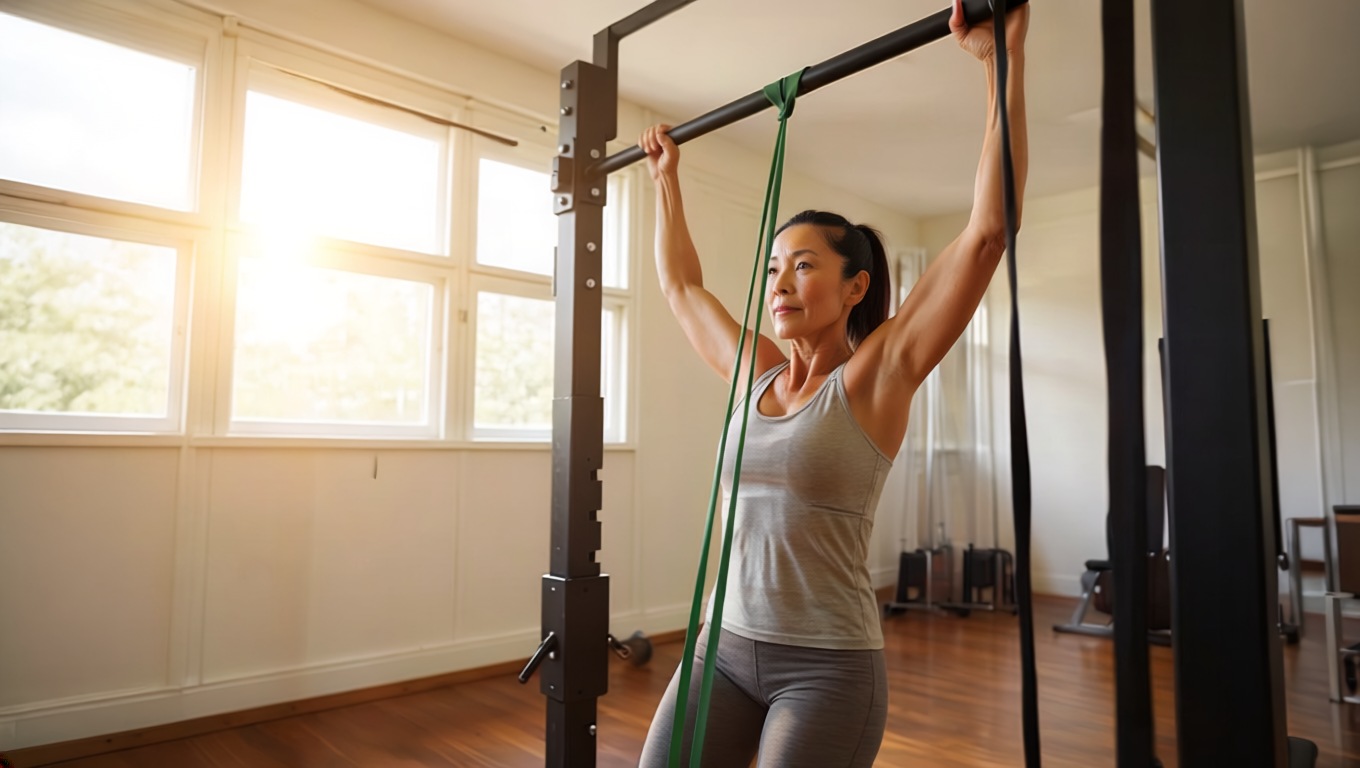
The pull-up progression for beginners has five stages: dead hang, scapular pulls, band-assisted reps, chin-ups, and the full pull-up. Train the progression 2 days a week, with 2–4 weeks per stage. Support work on 2 other days — rows, lat pulldowns, farmer carries — builds the muscles without hammering the same connective tissue.
By Deb Simpson, NASM Certified Personal Trainer — Deb coaches women over 40 who are building strength from the ground up.
For years, I’d go to the gym and use a machine called an assisted pull-up machine. I want you to sit with that name for a second. I didn’t, for three years. Assisted. Pull-up. Machine. In my mind, that machine was going to help me get a pull-up. It’s right there in the name.
I built a respectably strong back with the help of that thing. What I didn’t build was the ability to recruit my muscles in the right sequence at the right time to do a pull-up. And that’s the gap: the machine trains your back without ever asking your core to hold your body together. An actual pull-up asks for both at once — chest up, core braced, then pull with your back and biceps.
That sequence isn’t instinct. It’s built, piece by piece, starting with knowing what’s actually being asked of your body.
What a Pull-Up Actually Asks Of You
A pull-up executes on four systems: your grip holding the bar, your back and biceps doing the pulling, your shoulder blades stabilizing the joint, and your core keeping your trunk still enough that none of that effort leaks out as body swing. Miss any one of them and the movement doesn’t happen.
Your back, for pull-up purposes, is mostly the lats — the muscles doing the actual pulling. Your biceps assist once your elbows start bending, which is most of the movement. Your shoulder blades handle the stabilizing work underneath both of them.
Building all four takes a specific sequence, worked in order — not the only way to progress toward an unassisted pull-up, but certainly better than months on a machine that isn’t training the movement at all.
This progression needs two pieces of equipment: a pull-up bar and a resistance band. If you train at a gym, most have multiple bars you can use to practice pull-ups throughout the space. If you’re training at home, you can check out these curated options covering doorframe, wall-mount, and small-space setups if you don’t already have one. For the band, here’s a solid option.
That’s a real list of demands. If you want a program built to get you to your first pull-up, that’s Featherweight Fitness, where I train women over 40.
The Five-Step Progression
Watch the five stages in sequence: Pull-Up Progression for Beginners
Step 1: Dead Hang
Grip the bar, arms fully extended, shoulders pulled down and back — not shrugged up around your ears. Hold 10–30 seconds. This is grip strength and shoulder positioning, and it’s the base every other step sits on.
Step 2: Scapular Pulls
From the same hang, pull your shoulder blades down and together without bending your elbows. My own coach used to cue this as “shoulders in your back pockets” — same movement, easier to feel. Elbows stay straight; only your shoulder blades move. Scapular control gets trained on its own here, before any pulling load enters the picture.
Step 3: Band-Assisted Reps
Loop a resistance band over the bar, under your feet or knees, and perform the full pull-up motion with reduced load. This is the version that keeps you honest — the band takes weight off, but you’re still free-hanging, so your core still has to do its job.
Step 4: Chin-Ups
Underhand grip, full range of motion. More bicep involvement makes this feel more achievable early on, and that’s a legitimate bridge, not a shortcut.
Step 5: The Pull-Up
Overhand grip. Pull your chest toward the bar, not your chin over it — that’s the difference between a strict rep and a compensated one. One clean rep, full control, is the finish line here.
Support Work That Builds the Pull-Up
You can’t train the progression above every day — the grip, elbows, and shoulders doing that work need recovery between sessions. These exercises fill the other training days, working the same muscles through different movements so you’re building strength without hammering the same connective tissue on repeat:
| Exercise | What It Builds |
|---|---|
| Inverted Rows (bar, TRX, or rings) | Mid-back, scapular control |
| Dumbbell or Band Rows | Pulling mechanics, back strength |
| Lat Pulldowns | The pull-up pattern, under adjustable load |
| Straight-Arm Pulldowns | Lat isolation and control |
| Farmer Carries (kettlebells, dumbbells) | Grip strength, shoulder stability |
| Hollow Holds / Leg Raises | Core tension for strict reps |
Run the progression 2 days a week, these on 2 different days. If you want a coach helping you put this all together in a cohesive program, that’s what I do for women over 40 at Featherweight Fitness.
Timeline and What Changes Your Mechanics
Getting your first pull-up takes six to twelve weeks, typically — most people spend 2–4 weeks per stage before moving on. If you’ve seen pull-up in 30 days content, that’s probably someone starting from a higher baseline, not the standard “from scratch” path. There’s no shortcut through grip and scapular strength; they take the time they take.
Your starting bodyweight is part of that timeline too. Being heavier changes the mechanics, not the eligibility — more bodyweight to move means the earlier stages, the hang, the scapular pulls, the banded reps, are carrying more of the actual training load, so don’t rush past them.
Getting There
A pull-up asks for something specific: multiple muscle systems firing in the right sequence, dynamically, which a fixed machine can’t replicate. So if you’re serious about training for them, train the pieces that combine into the whole movement — dead hangs, scapular pulls, banded reps, chin-ups — plus the support work that makes each muscle group stronger on its own. That’s the clearer path to your first rep.
If you want a coach helping you build the strength this takes, that’s Featherweight Fitness — where I train women over 40.
Frequently Asked Questions
What’s the best pull-up progression for beginners?
Dead hangs, then scapular pulls, then band-assisted reps, then chin-ups, then the full pull-up. Each stage trains something the next one depends on.
How long does it take to get your first pull-up?
Six to twelve weeks for most people, training the progression 2 days a week through each stage.
Can a total beginner really do a pull-up?
Yes. The progression exists because a pull-up is a trained skill, not a fixed trait. Everyone who has one started at the dead hang.
Should I use the assisted pull-up machine?
For building back and arm strength, it works. For training a pull-up specifically, no — it removes the stability demand that makes a pull-up a pull-up. Bands do the same assistance job without removing that skill.
How often should I train for a pull-up?
Four days a week total: 2 days on the progression itself, 2 days on support work like rows and carries.
Keep Exploring
- Push-Up Modifications for Beginners — the other foundational bodyweight movement, same step-by-step approach.
- Best Pull-Up Bars for Beginners — what to buy if you’re training this at home.
- How to Choose a Dumbbell Weight — picking the right weight for the support work above.