
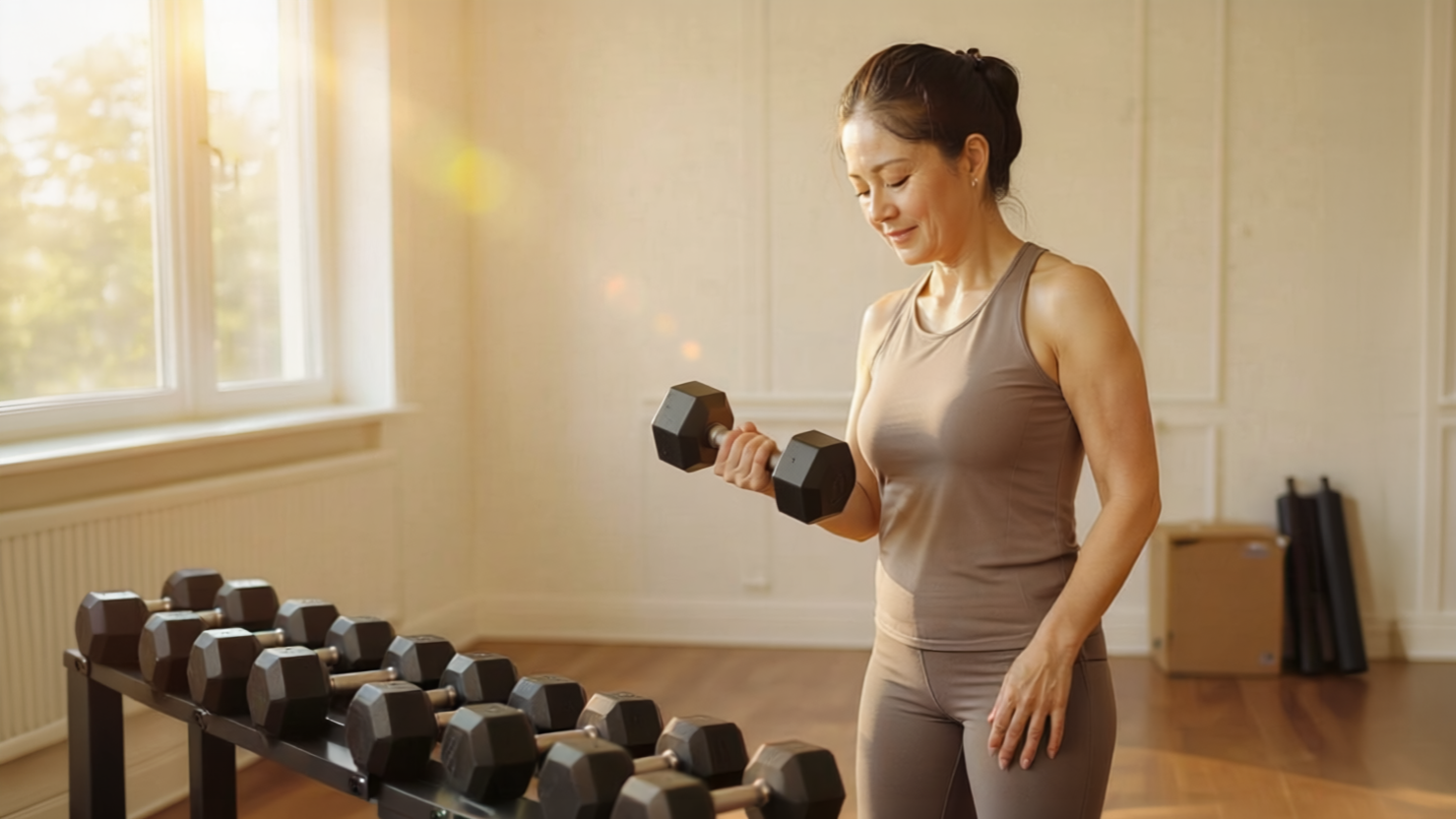
What weight dumbbells you should use depends on the exercise. Most women starting out work in the 6 to 15 pound range: 6 pounds for bicep curls and tricep extensions, 10 pounds for bench and shoulder press, 12 pounds for rows, and 15 pounds for goblet squats. Adjust based on form and control.
By Deb Simpson, NASM Certified Personal Trainer — Deb coaches women over 40 who are building strength from the ground up.
Most strength guides tell you to “start light” and move on. This one gives you real numbers.
If you’re new to lifting — especially as a woman over 40 — there’s a good chance no one ever showed you how to pick a starting weight. You’ve probably seen vague charts, been told to “just listen to your body,” or been handed pink 2 lb dumbbells like that constitutes a training plan.
Below is how to find your starting dumbbell weight, based on actual data from female beginner strength standards — not guesswork.
If you’d rather have someone else handle the programming while you focus on showing up and lifting, that’s what Featherweight Fitness is for. I work with women building strength from the ground up — starting weights included.
How to Choose the Right Dumbbell Weight as a Beginner
Your starting weight isn’t arbitrary. Five things determine it:
Age. Joint tolerance, coordination, and recovery capacity change over time. Muscle adapts faster than connective tissue — tendons and ligaments take longer to catch up. Your muscles may be ready for more. Your tendons, joints, and coordination may have other opinions. Older beginners need cleaner form, not heavier weight.
Body Weight. More body mass generally means more baseline strength, particularly in lower-body movements. It’s one variable, not the whole equation.
Experience Level. If you’ve never trained before, your nervous system hasn’t learned to recruit muscle efficiently yet. Start lower than you think. You’ll move up faster than you expect.
Target Muscle. Legs can handle significantly more load than arms. Biceps and triceps are small muscles — they don’t need the same weight as your back or legs to get challenged. Don’t use the same dumbbell across every exercise.
Confidence. If you’re bracing, compensating, or hesitating before every rep, the weight is too heavy. Control isn’t a consolation prize — it’s how you build strength that’s actually usable.
Recommended Starting Dumbbell Weights by Muscle Group
These numbers come from Strength Level’s female beginner standards — benchmarks built from real training data across a broad population of women. They’re general starting points, not tied to a specific bodyweight.
Your ideal working weight is roughly 75% of your estimated 1RM — meaning 75% of the maximum you could lift for a single rep. That range challenges you without collapsing your form in week one.
| Muscle Group | Exercise | Beginner 1RM (est.) | Start Here (75% 1RM) |
|---|---|---|---|
| Back | Dumbbell Bent Over Row | 17 lb | 12 lb |
| Biceps | Dumbbell Bicep Curl | 8 lb | 6 lb |
| Chest | Dumbbell Bench Press | 12 lb | 10 lb |
| Shoulders | Dumbbell Shoulder Press | 12 lb | 10 lb |
| Triceps | Dumbbell Tricep Extension | 7 lb | 6 lb |
| Legs | Goblet Squat | 20 lb | 15 lb |
Note: Weights are per dumbbell. For rows, curls, bench press, and shoulder press, you’ll use one dumbbell in each hand. For goblet squats and tricep extensions, you’ll hold a single dumbbell with both hands. These are starting points — adjust based on your form and control.
Starter Dumbbell Weight vs. Challenge Weight
There’s a difference between a weight that feels light and one that feels right.
- If you can’t complete your reps with clean form → it’s too heavy.
- If you breeze through without any real effort → it’s too light.
- If you feel challenged but in control → that’s your weight.
Start with 2–3 sets of 8–12 reps. When that becomes routine, it’s time to move up.
When to Increase Your Dumbbell Weight
This is called progressive overload — you gradually increase the demand on your muscles so they keep adapting. Without it, you plateau.
Look for these signals:
- You complete all your reps without any form breakdown.
- You’re not sore or challenged in the 24–48 hours after a workout.
- You finish your sets and feel like you had plenty left.
When that happens, increase weight by 5–10%. If that jump feels too large, fractional plates let you add smaller increments — useful when you’re sitting between standard dumbbell sizes.
Final Take: Build Smart, Not Just Strong
The fastest way to quit is to overload too early. The second fastest is to stay comfortable too long.
Start with weights that challenge without breaking your form. Track your reps. Add load when the signals tell you to. If you want a structured plan that handles the programming — starting weights and all — Featherweight Fitness is where to start.
Frequently Asked Questions
How do I know if a dumbbell is too heavy or too light?
A dumbbell is too heavy if you can’t complete your reps without breaking form — compensating, rushing, or losing control. It’s too light if you finish all your sets without any real effort. The right weight leaves you challenged but in control through your last rep.
When should I increase my dumbbell weight?
Increase when you can complete all your reps with clean form, you’re no longer feeling challenged during or after your workout, and you could comfortably do more. Go up by 5–10%. This is progressive overload — it’s how strength builds over time.
What dumbbell weight should a woman start with?
It depends on the exercise. Based on female beginner strength standards, most women starting out will work in the 6–15 lb range depending on the muscle group. Bicep curls and tricep extensions typically start around 6 lb; rows and goblet squats can start at 12–15 lb. Adjust based on your form and control.
Keep Exploring
- Best Dumbbells for Beginners — What to buy before you start lifting
- Best Fractional Weight Plates for Beginners — How to progress when standard dumbbell jumps are too large
- Beginner Strength Guide — How to build a strength foundation that actually holds