
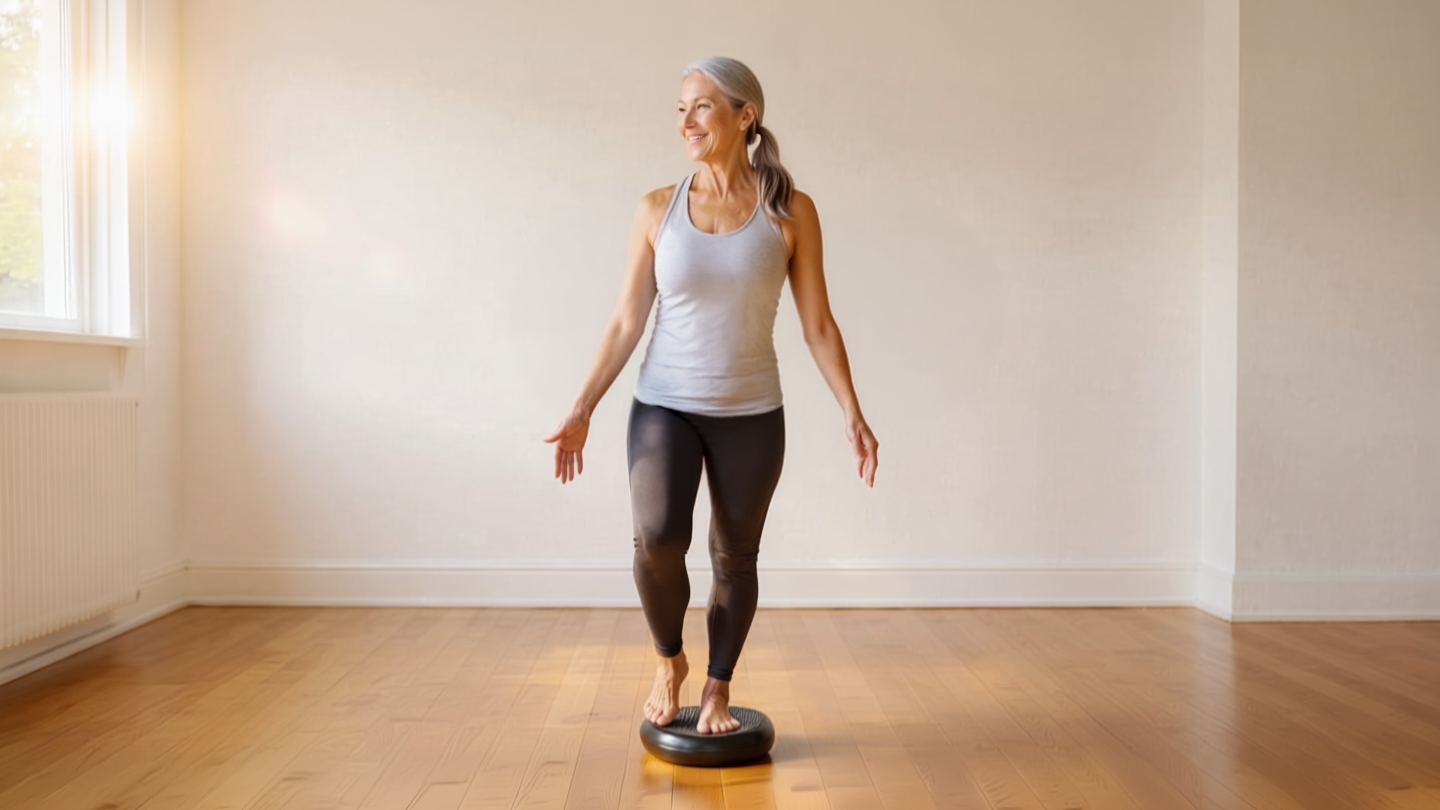
Stability disc exercises train the small stabilizer muscles in your ankles, hips, and core by forcing them to react to an unstable surface. The four core exercises are a two-foot balance hold, toe taps, side-to-side sways, and a one-leg hold. Done two to three times a week, most people notice steadier footing within four weeks.
By Deb Simpson, NASM Certified Personal Trainer — Deb coaches women over 40 who are building strength from the ground up.
A stability disc has been a part of my home gym setup for over a decade. Inner knee pain when I started running “faster.” Heel pain sharp enough to change how I walked some mornings. Hip pain that showed up out of nowhere. An ankle I had to rebuild after breaking it snowboarding. Every time something in my lower body goes sideways, the disc comes back out — to the point where balance work just lives in my warm-up now, because it’s easier than waiting for the next thing to break.
Most people wind up with a stability disc the same way I did: something broke, and someone — a physical therapist, a YouTube video, an article — suggested picking one up to fix it. Whatever the reason, you’re here for what to do with it now. Fair enough — here’s why it’s worth doing on a regular basis, not just when something already hurts:
Balance is one of the first things to go as we age — faster than strength. A 2024 study tracking single-leg stance time found it dropping about a fifth per decade on your weaker side, outpacing the decline in grip or knee strength over the same years.
It’s also a stronger predictor than most people assume. A study following 1,700 adults aged 51 to 75 found that people who couldn’t hold a 10-second one-legged stance had an 84% higher risk of death over the following years — even after adjusting for age, weight, and existing health conditions.
Poor balance isn’t the danger itself. It’s usually a sign that muscle, bone density, and reflexes are declining too — the things actually tied to that risk. Catching it early, with something as simple as balance work, means you’re not waiting for the rest to show up before doing anything about it.
The good news: it responds fast. Controlled studies in older adults show real, measurable improvement in as little as four to five weeks.
If you’d rather have someone walk you through progressions like this instead of piecing it together from a page, that’s what Featherweight Fitness is for — my personal training business, virtual and in-home coaching for women over 40. I work with women building strength from the ground up, balance included.
The Exercises
1. Basic Balance Hold
Step onto the disc with both feet, knees slightly bent, core engaged. Hold for 15–30 seconds. This is the baseline — if it’s still shaky, stay here before moving to anything else on the list.
2. Toe Taps
One foot planted on the disc, the other tapping forward and back on the floor. The standing leg is doing the actual work — the tapping leg is just there to try to pull you off balance.
3. Side-to-Side Sways
Both feet on the disc, shifting weight left to right in a controlled, deliberate motion. Slower is harder here — a fast sway lets momentum do the balancing for you instead of your muscles.
4. One-Leg Hold
One foot on the disc, the other lifted slightly off the ground. Hold, then switch sides. This is the hardest of the four, and it’s normal for it to look nothing like the video the first several tries.
| Exercise | Sets | Reps | Cue |
|---|---|---|---|
| Basic Balance Hold | 3 | 15–30 sec hold | Knees soft, core braced |
| Toe Taps | 3 | 10–12 per foot | Slow and controlled, not fast |
| Side-to-Side Sways | 3 | 10–12 per side | Weight evenly split between both feet |
| One-Leg Hold | 3 | 15–30 sec hold | Lower the lifted leg slowly |
Do this two to three times a week, resting 30–45 seconds between sets and taking at least one full day off between sessions. These are small stabilizer muscles, and they need recovery like any other muscle group.
Four consistent weeks on the disc should be enough to notice something concrete — catching yourself faster when you stumble, less effort to cross uneven ground, sturdier footing on stairs you used to take carefully.
If you want a coached plan for what comes after the balance work, Featherweight Fitness — my personal training business for women over 40 — is where to start.
Frequently Asked Questions
Do balance discs actually work?
Yes, for what they’re built for — proprioception and the small stabilizing muscles in your ankles, hips, and core. They’re not a substitute for strength training, and they won’t fix balance problems caused by an underlying medical condition. For general age-related decline, controlled research shows measurable improvement within four to five weeks.
What are the benefits of stability disc exercises?
Better proprioception, stronger stabilizing muscles that everyday movement doesn’t reach, and — the part that actually matters day to day — more confidence on uneven or unpredictable ground.
Is a stability disc good for beginners?
Yes. Start with both feet on the disc before progressing to single-leg work. Don’t rush past the Basic Balance Hold if it’s still unsteady — that’s the foundation everything else on this list depends on.
How long does it take to see results from balance training?
Around four to five weeks of consistent practice, based on controlled studies in older adults.
Can balance training help prevent falls?
It’s one piece, not the whole strategy. It improves the reflexes that catch you when your footing shifts. It doesn’t touch vision, medication side effects, or home hazards — but it’s a real piece you have direct control over.
Keep Exploring
- Pairing this with the right equipment? Our stability trainer buying guide covers what’s actually worth buying versus what’s marketing.
- Want the rest of a beginner program to go with this? Our beginner workout plan for women over 40 covers the strength side.
- Next in the balance/core cluster? Building Balance and Core Strength: Start Here — no equipment required.