
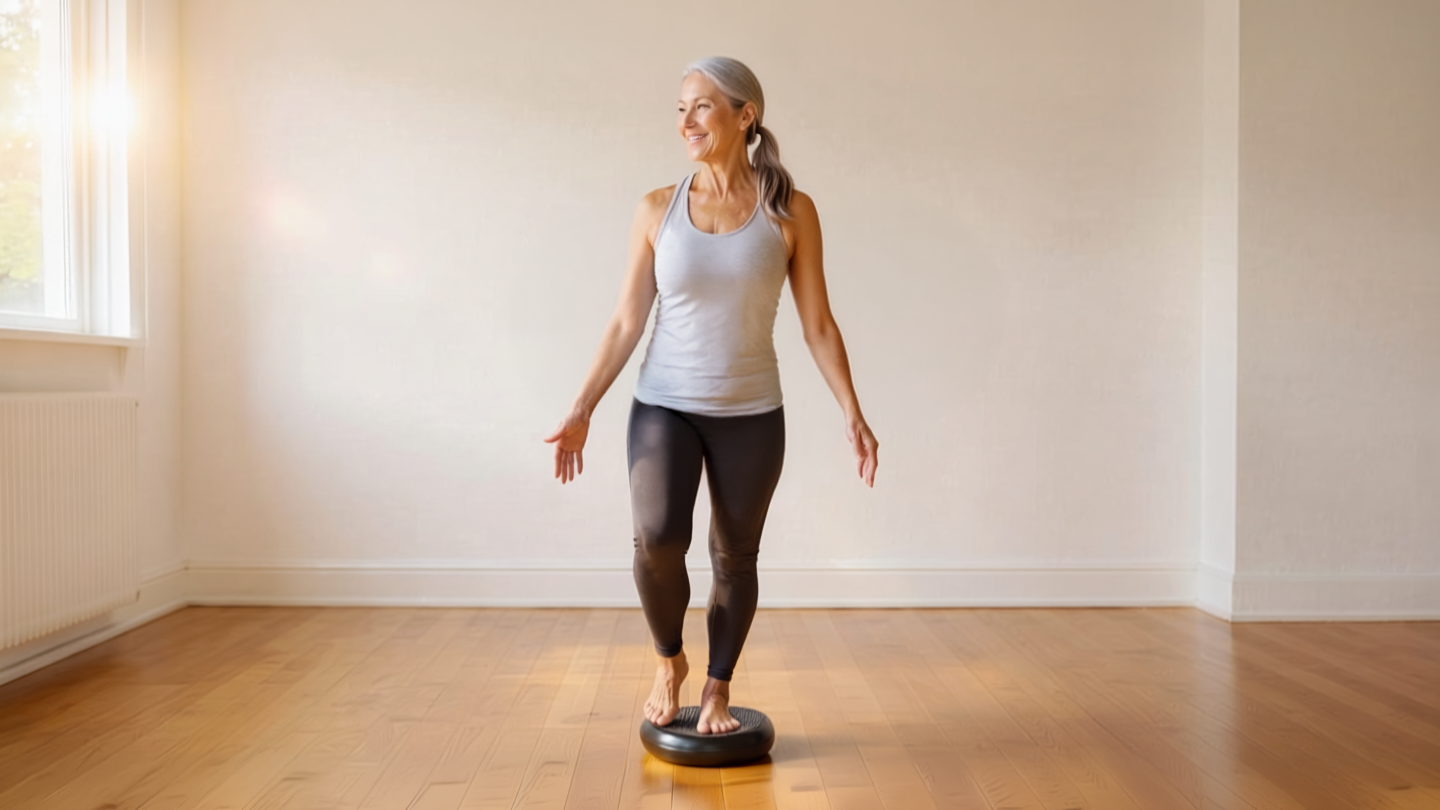
Building balance and core strength starts by training the three areas that go quiet with age: hips, ankles, and core. Do a routine of seven bodyweight exercises 2 to 3 times a week: single-leg stand, tri-planar toe taps, step-ups, step-downs, sit-to-stand, dead bug, and knee plank with shoulder taps.
By Deb Simpson, NASM Certified Personal Trainer — Deb coaches women over 40 who are building strength from the ground up.
I learned a lot about rebuilding balance when I broke my ankle snowboarding, at the age of 45. I know, it sounds impressive. It was not, and I would like to speak to whoever is in charge of how first-time snowboarding experiences at 45 are supposed to go.
Once I was cleared to bear weight and started moving around again, I noticed something genuinely disconcerting: my balance was markedly worse on both sides, not just the ankle I broke.
Who knew that weeks of zipping around the house on a knee scooter would do that?
That got me curious — why would the ankle that never broke lose ground too? Turns out balance runs through your hips, ankles, and core together, and it goes quiet just as fast from disuse as it does from injury. Maybe you’ve noticed it too — gripping the stair rail a little tighter than you used to, or a slip on ice that rattled you more than it should have. Same mechanism, different trigger.
That core piece is worth unpacking. Most people think of the core as the visible ab muscles some people get at a high level of leanness. But your core is also the deep muscles wrapping around your spine and pelvis, working together like a natural corset. Their job is bracing your spine a split second before you move — reaching for something, going down a step, catching yourself when the ground surprises you. Like the muscles in your hips and ankles, that bracing reflex gets slower without practice — and balance slows right along with it.
None of this is permanent. Balance and the core strength behind it are trainable — these are the exercises that rebuilt mine, and they target the exact three places that go quiet: hips, ankles, and core.
Every exercise below uses just your bodyweight, a stair, and a sturdy chair. When you’re ready for more challenge, a stability disk trains the same balance and core skill on an unstable surface instead of a stable one: Balance and Stability Disk Exercises for Beginners.
If you’d rather have someone map out which balance and core work you actually need instead of guessing your way through a list of exercises, that’s what Featherweight Fitness is for. I work with women building strength from the ground up — including the coordination and control work most programs skip entirely.
The Exercises
Do this routine 2 to 3 times a week. Balance and core control respond to frequent, brief practice — you don’t need to feel wiped out afterward for it to be working.
Rest 30–45 seconds between sides on Single-Leg Stand and Toe Taps — that’s coordination practice, not exertion, so you recover fast. For everything else, rest 60–90 seconds between sets; 30 seconds is fine if that’s what you’ve got.
Single-Leg Stand

Target muscles: Ankle stabilizers, hip stabilizers (glute medius), core
Stand near a wall or sturdy chair for a light fingertip touch if you need it — not to lean on, just to have there. Lift one foot a few inches off the floor and hold. Keep your standing knee soft, not locked, and don’t let the lifted-leg side of your hips drop. Hold for time, then switch sides.
Easier: Keep two fingers on the wall or chair for the entire hold, or shorten the time.
Harder: Close your eyes, or stand on a folded towel.
Tri-Planar Toe Taps

Target muscles: Hip stabilizers, ankle control, core
Standing on one leg (same setup as above), tap your free foot forward, then out to the side, then behind you, returning to center each time. Your standing leg is doing the work — the moving foot is a light tap, not a kick. Keep your standing hip level through all three directions.
Easier: Reduce the range of motion on each tap. A small, controlled tap beats a big reach that tips you over.
Harder: Slow the tempo — a 2-second tap out, 2-second return.
Step-Ups

Target muscles: Quads, glutes, hamstrings, core
Use a step, a sturdy stair, or a low platform that doesn’t wobble. Step up fully with one leg, driving through the heel, until that leg is straight and you’re standing tall on top. Step back down with control. Finish all reps on one side before switching.
Easier: Use a lower step.
Harder: Use a higher step, or slow the step-down to a 3-second count, or add a pair of light dumbbells once bodyweight feels easy.
Step-Downs

Target muscles: Quads, glutes, core (eccentric control)
From standing on the step, lower one leg toward the floor with control until your heel just taps or nearly taps, then push back up. The work happens on the way down, not the way up.
Easier: Use a lower step, or stop the descent early and push back up before your heel gets close to the floor.
Harder: Slow the descent to a 3–4 second count, or pause for two seconds at the bottom before pushing back up.
Sit-to-Stand

Target muscles: Quads, glutes, hamstrings, core
Sit on the edge of a sturdy chair, feet flat on the floor. Stand up without using your hands, then sit back down with control — don’t drop into the seat. That’s one rep.
Easier: Use a higher chair, or allow a light push-off from your thighs.
Harder: Use a lower chair, or pause just before your seat touches down before standing back up.
Dead Bug

Target muscles: Deep core (transverse abdominis), hip flexors
Lie on your back, arms reaching straight up toward the ceiling, knees bent at 90 degrees over your hips. Press your lower back flat into the floor and keep it there through the set. Slowly lower one arm overhead and the opposite leg toward the floor, stopping the instant your lower back starts to lift off the ground — that’s your working range for today. Return to start and switch sides.
Easier: Move just the arm or just the leg, not both together, until the combined movement feels controlled.
Harder: Lower both arms and both legs at the same time, same rule about your lower back.
Knee Plank with Shoulder Taps

Target muscles: Core (anti-rotation), shoulders
Plank position with your hands under your shoulders and your knees on the floor instead of your toes — straight line from knees to head. Keeping your hips still, lift one hand and tap the opposite shoulder, then set it back down. Alternate sides. The goal is zero hip movement — if your hips rock with each tap, slow down or reduce how far you reach.
Easier: Hold the plank without tapping first, and add taps once the hold feels stable.
Harder: Move from knees to toes (full plank), then add the taps once that feels stable.
Quick Reference
| Exercise | Sets | Reps / Hold |
|---|---|---|
| Single-Leg Stand | 2 | 20–30 sec per side |
| Tri-Planar Toe Taps | 2 | 8 taps per direction, per leg |
| Step-Ups | 3 | 8–10 per leg |
| Step-Downs | 3 | 8–10 per leg |
| Sit-to-Stand | 2 | 10–12 |
| Dead Bug | 2 | 6–8 per side |
| Knee Plank with Shoulder Taps | 2 | 6–8 taps per side |
Add reps before you add sets. When the current version stops challenging you before you hit the top of the range, that’s your cue to move to the harder variation — not to rush the timeline.
Start with the regression of each exercise if the base version breaks down before you hit your target reps. Add the harder version only once the current one is clean. If you’d rather have someone else make that progression call for you, Featherweight Fitness is where to start.
Frequently Asked Questions
What’s the best exercise to improve your balance?
There isn’t a single one — balance comes from your hips, ankles, and core working together, not one muscle group carrying the load. Single-leg work is the foundation everything else builds on: Single-Leg Stand and Tri-Planar Toe Taps train the same reactions you use catching yourself on uneven ground, which is why they come first in this routine, before the movement-based exercises like Step-Ups and Step-Downs.
How do you fix poor balance as you get older?
Practice, specifically aimed at the systems involved — the muscles in your hips, ankles, and core that react when you’re off balance. It’s a skill, and skills respond to consistent practice at any age. That’s what every exercise in this routine is built to train.
Can a weak core actually cause balance problems?
Yes. Your core’s job includes keeping your spine and pelvis stable while your limbs move — which is exactly what’s happening every time you shift your weight onto one leg. A core that can’t hold that position under a much smaller load, lying on the floor, isn’t going to hold it standing on one foot either.
What core muscles are actually involved in balance?
Mainly the deep stabilizers — transverse abdominis, obliques, and the muscles around your pelvis and lower back — not the ones that show up when you talk about “abs.” Their job is control, not movement, which is why Dead Bug and Knee Plank with Shoulder Taps train them more directly than a crunch would.
How long before balance actually improves?
Balance is a skill, and skills respond to consistent practice faster than strength does. Most people notice a real difference in single-leg stability within 2 to 4 weeks — not because the muscles got bigger, but because the coordination got better.
Keep Exploring
- Ready to add instability training? Balance and Stability Disk Exercises for Beginners trains the same balance and core skill on an unstable surface.
- New to strength training entirely? Start here: Beginner Strength Guide
- Working through the push-up progression? This piece pairs directly with wherever you are in that progression: Push-Up Modifications for Beginners