
Affiliate Disclaimer:
Some of the links on this page are affiliate links, meaning if you click through and make a purchase, we may earn a small commission at no additional cost to you. We only recommend products and services that we believe will add value to our audience. Your support helps us continue to create content and provide helpful information. Thank you!
By Deb Simpson, NASM Certified Personal Trainer — Deb coaches women over 40 who are building strength from the ground up.
- Why a Stability Ball Belongs in Your Home Gym
- What Size Stability Ball Do You Need?
- The Best Stability Balls for Beginners: 3 Picks for Home Gyms
- Find Your Size, Then Start
- Frequently Asked Questions
Why a Stability Ball Belongs in Your Home Gym
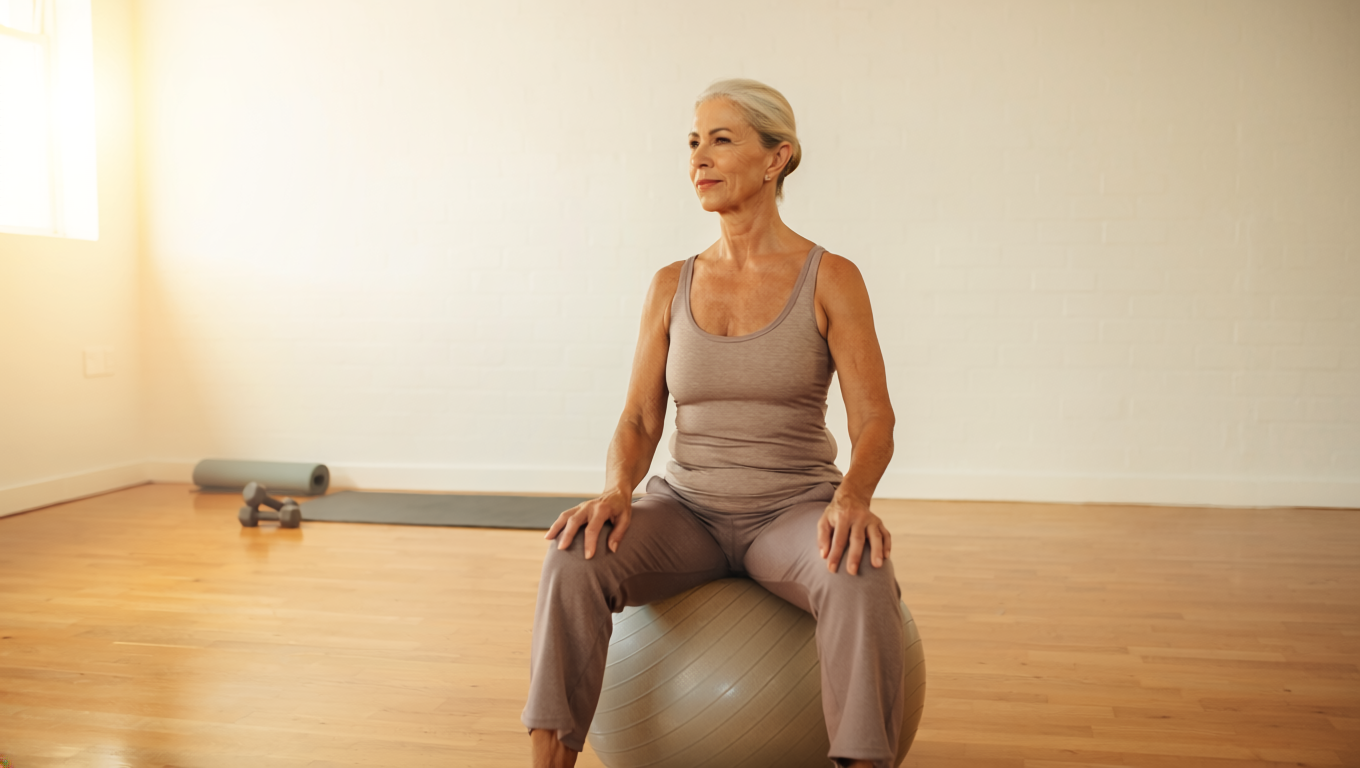
A stability ball looks simple. It’s just an inflated ball. But put your hands on it for a plank, sit on it for a press, or try a crunch — and you’ll immediately feel muscles working that a flat surface never reaches. That’s the whole point. The instability forces your core to engage constantly, not just during the movement, but throughout it.
For women over 40, that kind of integrated core strength matters more than most people realize. It underpins posture, balance, and how you move through daily life. A stability ball gets you there with low joint stress and almost no learning curve — you can use it for seated exercises, floor work, or even swap it in as a desk chair to build core engagement into your workday.
Before you choose a ball, size matters more than brand. Get the diameter wrong and every exercise becomes harder to control — the instability works against you instead of for you. Start with the sizing chart below, then pick the ball that fits your setup. If you want help building stability ball work into an actual training plan, Featherweight Fitness is where I work with women over 40 one-on-one to build routines that stick.
What Size Stability Ball Do You Need?
The right ball puts your hips level with or slightly above your knees when seated. Use this as your starting point — then confirm available sizes for whichever ball you choose.
| Diameter | Height Range |
|---|---|
| 45cm | Under 5′ |
| 55cm | 5’–5’6″ |
| 65cm | 5’6″–6′ |
| 75cm | 6’–6’5″ |
| 85cm | 6’5″+* |
*85cm is available from Black Mountain Products only. If you fall between two sizes, size up for more challenge or size down for more control. If you’re buying the ball to use as a desk chair, size to your desk instead of your height — most adults land on 65cm at a standard 29–30″ desk. Ranges based on manufacturer guidelines from TheraBand and Black Mountain Products.
The Best Stability Balls for Beginners: 3 Picks for Home Gyms
| Product | Size Range | Beginner Guidance | Best For |
|---|---|---|---|
| Black Mountain Products Exercise Stability Ball | 45–85cm | Printed starter guide | Hard-to-fit heights |
| Fitmind Extra Thick Yoga Ball | 45–75cm | Illustrations on the ball | Learning form as you go |
| TheraBand Exercise and Stability Ball | 45–75cm | 24-exercise poster | A clinic-proven first ball |
Black Mountain Products Exercise Stability Ball
If you’ve ever bought a stability ball and found it sat too low or too high no matter how you inflated it, this is the one that fixes that. Black Mountain runs five diameters from 45cm to 85cm, so the fit works at heights the others leave out. It’s independently tested to 2,000 pounds of static strength, so whether the ball will hold isn’t something you’ll spend time thinking about.
It ships with a foot pump and a starter brochure, which takes the friction out of getting started. Black Mountain backs it with a manufacturer’s warranty.
What Makes It Stand Out:
- Five diameters, 45cm to 85cm — the widest range in this guide
- Tested to 2,000 lbs static strength
- Manufacturer’s warranty
- Includes foot pump and starter brochure
- Anti-burst construction
Whatever your height, there’s a size here that fits.
Fitmind Extra Thick Yoga Ball
The Fitmind ball is built around one specific promise: it won’t suddenly fail under you. The 2mm wall thickness and micro-porous foam construction mean that if it’s ever punctured, it deflates slowly rather than bursting — the difference between a controlled stop and a fall. With a 660 lb dynamic load capacity and 1,100 lb static capacity, it handles the real stresses of active core work.
What separates this one practically is the embossed movement guide printed directly on the surface. If you’re just starting out and aren’t sure how to position for different exercises, the ball shows you without needing to stop and look anything up. It also works as a desk chair or prenatal exercise ball if either applies.
What Makes It Stand Out:
- 660 lb dynamic / 1,100 lb static load capacity
- 2mm wall thickness with micro-porous anti-burst construction
- Embossed exercise illustrations on the surface — built-in guidance for beginners
- Multiple sizes available
- Doubles as a desk chair or birthing ball
- 180-day satisfaction guarantee
If you want the most structurally reassuring option with built-in beginner guidance, this one earns it.
TheraBand Exercise and Stability Ball
TheraBand is what you find in physical therapy offices and rehab clinics — equipment that gets used by a different person every hour, all day, and keeps working. It deflates slowly if punctured rather than bursting, and it comes with a 24-exercise guide poster. One thing to know before you order: no pump is included. TheraBand sells one separately, and any exercise ball pump will do.
One trainer note: when a ball is the wrong size, the instability that’s supposed to be working for you starts working against you. Exercises get harder to control, not more effective. Match the diameter to the sizing chart above, and you’ll feel the difference immediately.
What Makes It Stand Out:
- Clinic-trusted brand
- Multiple sizes available across the full height range
- Includes 24-exercise guide poster
- Deflates slowly if punctured
- Easy to clean
- Pump sold separately
Tried and trusted. If you want a reliable entry point from a brand that performs in professional settings, this is it.
Find Your Size, Then Start
Match the diameter to your height using the chart above, then pick based on what you need. If you’re at either end of the height range, Black Mountain is the only one here that goes to 85cm and still offers a 45cm. If you’re not confident on form yet, the Fitmind has the movements printed on the ball itself. And if you want the ball your physical therapist would hand you, that’s the TheraBand — just order a pump with it.
Get the right size, inflate it, and start. Even seated core exercises with a stability ball build the kind of deep muscle engagement that carries over into everything else you train.
If you want a trainer to build that into a full plan, Featherweight Fitness is where to start.
Frequently Asked Questions
What size stability ball do I need?
Match the ball diameter to your height. Under 5′ use a 45cm ball; 5′ to 5’6″ use 55cm; 5’6″ to 6′ use 65cm; 6′ to 6’5″ use 75cm; 6’5″ and above use 85cm. The right size puts your hips level with or slightly above your knees when seated. Using the wrong size makes exercises harder to control and reduces how effectively your core has to work.
What is the weight limit on a stability ball?
Weight limits vary by ball. The Black Mountain Products ball in this guide is tested to 2,000 lbs of static strength. The Fitmind ball supports a 660 lb dynamic load and 1,100 lb static. Most quality stability balls are rated well above the average user’s body weight, but always check the dynamic load capacity specifically, since that reflects real exercise forces rather than sitting weight alone.
Are stability balls good for beginners?
Yes. Stability balls are among the most beginner-friendly core training tools available. They require no prior fitness experience, put minimal stress on joints, and work for seated exercises, floor movements, or even as a desk chair substitute. The instability forces your core to engage throughout every movement, making even simple exercises effective. Start with seated or supported movements and build from there.
What size stability ball should I use as a desk chair?
Size to your desk, not your height. The height chart above is for floor exercise, where you want your hips level with or slightly above your knees. At a desk you want your elbows near 90 degrees with your forearms level to the desk surface — and desk height is fixed at about 29 to 30 inches no matter how tall you are. Most adults land on 65cm. Under about 5’4″, try 55cm; over 6′, try 75cm. Keep in mind that a ball chair suits intermittent use better than sitting all day, since there’s no back support.
Keep Exploring
- Best Stability Trainers for Beginners: Balance discs, BOSU balls, and wobble boards — the next level of instability training for core and balance.
- Best Foam Roller for Recovery & Mobility: Core work creates muscle fatigue. This is the recovery tool that pairs with it.
- The Best Yoga Mats for Beginners: Floor-based stability ball exercises need a surface that keeps you grounded.