
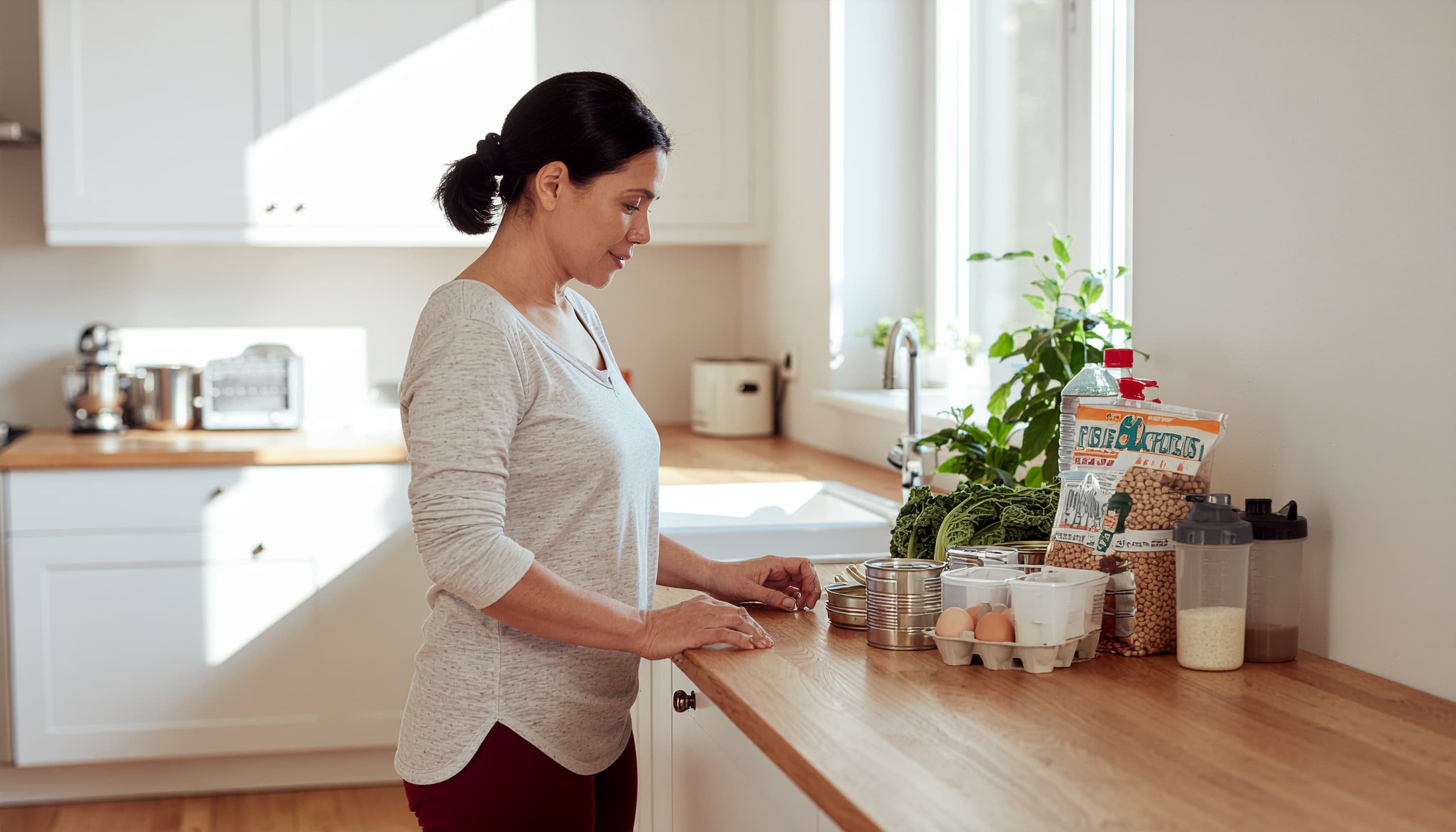
The best protein sources rank differently depending on whether you sort by cost, protein density, or prep time. Lentils are the cheapest at $0.01 per gram of protein. Canned tuna is the most protein-dense at 92% of calories from protein. Canned tuna also leads the grab-and-go category with zero prep.
Affiliate Disclaimer:
Some of the links on this page are affiliate links, meaning if you click through and make a purchase, we may earn a small commission at no additional cost to you. We only recommend products and services that we believe will add value to our audience. Your support helps us continue to create content and provide helpful information. Thank you!
By Deb Simpson, NASM Certified Personal Trainer — Deb coaches women over 40 who are building strength from the ground up.
- Find Your Protein Sources
- Easy Protein Swaps for Meals You Already Make
- When “Protein” Is Just a Label
- Frequently Asked Questions
Search “best protein sources” and every result gives you the same four answers. Chicken breast. Eggs. Greek yogurt. Tuna. Those aren’t wrong — but four options don’t go very far when most of your week is some version of “it depends.” Depends on the budget, depends on what’s in the fridge, depends on whether you have thirty minutes to cook or twelve minutes between drop-off and a conference call.
You need more options, and a way to sort them. That comes down to three things:
Cost — what a gram of protein actually costs, not what the package costs
Protein density — how much of each item’s calories are protein versus filler
Prep time — how much time stands between you and eating it
A list built around cost ignores protein density. Built around density, it ignores prep time. Built around what’s fastest, it ignores both — and fast is where the food industry has made it easiest to grab something that barely qualifies as a protein source at all.
Find Your Protein Sources
Three rankings. Three different answers.
Price
Most women over 40 need somewhere around 100 to 150 grams of protein a day — way more than most of us are actually eating. If you haven’t figured out your number yet, here’s where to start. Either way, that’s a lot of protein to add to a grocery bill that’s already feeding people who aren’t counting grams of anything.
The immediate question is what this actually costs — and the answer depends on what you’re measuring. The price on the shelf tells you what you’re paying for the package. It doesn’t tell you what you’re paying for the protein inside it.
Skim milk costs $0.09 per 100 grams. Peanut butter costs $0.65 — more than seven times as much. But skim milk delivers 3.8 grams of protein in that same 100 grams, and peanut butter delivers 21.9. Divide cost by protein and the gap nearly disappears: skim milk is $0.02 per gram of protein, peanut butter $0.03. The seven-to-one sticker-price difference was mostly water and packaging.
That’s the math behind this ranking:
Cost per Gram of Protein = Price per 100 Grams ÷ Protein per 100 Grams
It strips out package size, serving count, and unit pricing, and tells you what one gram of protein actually costs.
Lentils top this list at a penny per gram. They’re not the most protein-dense option here — that’s a different ranking, and it’s next — but gram for gram, nothing touches them on price.
Prices current as of July 2026.
| Item | Price per 100 Grams | Protein per 100 Grams | Cost per Gram of Protein |
|---|---|---|---|
| Lentils | $0.32 | 22.86g | $0.01 |
| Skim Milk | $0.09 | 3.81g | $0.02 |
| Raw Chicken Breast | $0.59 | 21.43g | $0.03 |
| Edamame | $0.34 | 11.58g | $0.03 |
| Large Eggs | $0.38 | 12.00g | $0.03 |
| Whole Milk | $0.09 | 3.39g | $0.03 |
| 2% Milk | $0.09 | 3.39g | $0.03 |
| Peanut Butter | $0.65 | 21.88g | $0.03 |
| Canned Chickpeas | $0.20 | 5.38g | $0.04 |
| Anthony’s TVP | $2.20 | 53.33g | $0.04 |
Protein Density
Getting to 100-plus grams of protein a day means protein has to take up a real share of your total calories. If the foods you’re eating to get there carry a lot of fat, carbs, and sugar along for the ride, you run out of calorie room before you hit your protein number.
How much rides along varies wildly, even between foods with nearly identical protein on the label. Peanut butter and chicken breast both deliver about 22 grams of protein per 100 grams. But peanut butter carries 594 calories to get there. Chicken breast carries 98. Same protein, six times the calories. Peanut butter ranked in the price top 10. It doesn’t appear anywhere near this list — 85% of its calories aren’t protein. They’re fat and carbs that came prepackaged with it.
That’s what this formula measures:
% Calories from Protein = (Protein per 100 Grams × 4) ÷ Calories per 100 Grams
Every gram of protein has 4 calories. Multiply protein grams by 4, divide by total calories, and you get the percentage that’s actually protein. Higher percentage of calories from protein means a more efficient protein source.
Prices current as of July 2026.
| Item | Calories per 100 Grams | Protein per 100 Grams | % Calories from Protein |
|---|---|---|---|
| Canned Tuna in Water | 88.5 | 20.35g | 92.0% |
| Premier Protein Shake | 41.0 | 9.2g | 89.8% |
| Raw Chicken Breast | 98.2 | 21.43g | 87.3% |
| Liquid Egg Whites | 54.3 | 10.87g | 80.1% |
| Optimum Nutrition Whey Powder | 387.1 | 77.40g | 80.0% |
| Fairlife Shake | 44.1 | 8.82g | 80.0% |
| Anthony’s TVP | 300.0 | 53.33g | 71.1% |
| Oikos Triple Zero Yogurt | 60.0 | 10.00g | 66.7% |
| Oikos Pro Yogurt | 94.1 | 14.71g | 62.5% |
| Evolve Vegan Protein Shake | 42.4 | 6.1g | 57.5% |
Prep Time
There are gaps in every day where a real meal isn’t happening — the stretch between school drop-off and a 9am that’s going to go better if you’re not hangry, the afternoon slot where dinner is still hours off. That’s what this list is for.
Everything on this list is zero prep — grab it, open it, eat it. The ranking is by protein density, not cost, because same convenience does not mean same math.
Prices current as of July 2026.
| Item | % Calories from Protein | Cost per Gram of Protein |
|---|---|---|
| Canned Tuna in Water | 92.0% | $0.04 |
| Premier Protein Shake | 89.8% | $0.08 |
| Fairlife Shake | 80.0% | $0.11 |
| Oikos Triple Zero Yogurt | 66.7% | $0.08 |
| Oikos Pro Yogurt | 62.5% | $0.07 |
| Evolve Vegan Protein Shake | 57.5% | $0.13 |
| Quest Protein Chips | 48.0% | $0.13 |
| Cottage Cheese Snack Cups | 48.0% | $0.08 |
| AGRO Power Jerky | 44.4% | $0.21 |
| Skim Milk | 40.0% | $0.02 |
The cheapest options mostly need cook time. The most convenient options with good density cost more per gram. No single food wins all three. Which tradeoff matters most depends on your budget, your calorie situation, and how much time you actually have — and that changes week to week. The tool below lets you rank everything by your own priorities.
If you’d rather have someone build the nutrition and training plan together instead of sorting through the tradeoffs yourself, that’s what Featherweight Fitness is for — virtual and in-home personal training for women over 40, based in Chesapeake, VA. I work with women building strength from the ground up, programming and protein strategy included.
Pick the one that’s tightest this week. You get three lists: your priority applied to everything above, then the same ranking with the other dimensions factored in. So if your number one priority this week is cost, we’ll also show you the cheapest protein-dense options and the cheapest grab-and-go options. That way, as the week unfolds you’ve got solutions for whatever comes up, without having to do the math.
What’s tightest this week?
Tap one — your results load right below.
Easy Protein Swaps for Meals You Already Make
The rankings above tell you what to look for. These swaps are what those numbers look like inside meals you’re already making — same food, same satisfaction, different protein math.
Prices current as of July 2026.
Plant-Based Hot Dogs vs. Beef Hot Dogs
Same backyard staple, opposite numbers. The plant-based version wins on both cost per gram and protein density. Not a tradeoff — a straight upgrade.
| Lightlife Smart Dogs | Oscar Mayer Beef Franks | |
|---|---|---|
| Cost per Gram of Protein | $0.08 | $0.11 |
| % Calories from Protein | 56.0% | 14.3% |
MorningStar Chik’n Patties vs. BOCA Burger
Both plant-based, wildly different formulations. BOCA delivers more than double the protein density at less than half the cost per gram. Same freezer aisle, same cook time. Same category on the label, completely different product in the math.
| MorningStar Chik’n Patties | BOCA Burger | |
|---|---|---|
| Cost per Gram of Protein | $0.13 | $0.06 |
| % Calories from Protein | 22.5% | 46.7% |
Protein Oatmeal vs. Regular Oatmeal
Kodiak Cakes Oatmeal has nearly double the protein density of plain Quaker. It also costs more than three times as much per gram of protein. The tradeoff is real — better density, significantly higher cost. Whether it’s worth it depends on whether your grocery budget or your calorie budget is tighter.
| Kodiak Cakes Oatmeal | Quaker Oats | |
|---|---|---|
| Cost per Gram of Protein | $0.14 | $0.04 |
| % Calories from Protein | 25.3% | 13.3% |
Protein Waffles vs. Regular Waffles
Jimmy Dean’s protein waffle costs half as much per gram of protein as a regular Eggo and delivers nearly four times the density. Same toaster, same two minutes.
| Jimmy Dean Protein Waffles | Eggo Homestyle Waffles | |
|---|---|---|
| Cost per Gram of Protein | $0.07 | $0.14 |
| % Calories from Protein | 33.3% | 8.9% |
Protein Ice Cream vs. Regular Ice Cream
The cost per gram of protein is nearly identical — the price difference between these two is negligible. The density difference is not. Halo Top puts four times more of its calories toward protein.
| Halo Top | Häagen-Dazs Caramel Cone | |
|---|---|---|
| Cost per Gram of Protein | $0.25 | $0.26 |
| % Calories from Protein | 21.8% | 5.3% |
When “Protein” Is Just a Label
The swaps above work because the products behind them deliver. Not everything with “protein” on the label does. The word used to mean the product was formulated for serious training. Now it means a marketing team noticed the trend.
Protein Pop-Tarts
10% of calories from protein — tied for the lowest protein density in the entire dataset. The regular version sits at 5.4%. The “Protein” label nearly doubled the density and it’s still at the bottom. At $0.10 per gram of protein, you’re paying a premium for the word on the box.
| Protein Pop-Tarts | Regular Pop-Tarts | |
|---|---|---|
| Cost per Gram of Protein | $0.10 | $0.13 |
| % Calories from Protein | 10.0% | 5.4% |
Special K Protein Cereal
The “Protein” version has 19.1% protein density. Regular Special K has 18.7%. Less than half a percentage point. The label changed. The product didn’t.
| Special K Protein Cereal | Regular Special K | |
|---|---|---|
| Cost per Gram of Protein | $0.07 | $0.10 |
| % Calories from Protein | 19.1% | 18.7% |
CLIF Bar vs. CLIF Builders Bar
Same company, same word on the packaging, very different products. The regular CLIF Bar runs 16% protein density at $0.16 per gram. The Builders Bar — their protein-focused line — comes in at 28.6% density and $0.13 per gram. Cheaper per gram and nearly double the density. “Protein” apparently means different things on different boxes, even from the same brand.
| CLIF Bar | CLIF Builders Bar | |
|---|---|---|
| Cost per Gram of Protein | $0.16 | $0.13 |
| % Calories from Protein | 16.0% | 28.6% |
Jack Link’s Beef Jerky
Jerky has a reputation as the smart protein snack. Most commercial brands don’t earn it — Jack Link’s, the one you’re most likely to grab, comes in at $0.29 per gram of protein and 16.7% density. Quality jerky is a different product entirely. No Man’s Land Slow-Dried Beef Jerky delivers 75.6% density at $0.20 per gram — but at $28.99 for 8.5 ounces, you’re ordering online, not grabbing it at a gas station.
| Jack Link’s Beef Jerky | No Man’s Land | |
|---|---|---|
| Cost per Gram of Protein | $0.29 | $0.20 |
| % Calories from Protein | 16.7% | 75.6% |
Pick the meal that’s weakest on protein right now and fix that one first. For most people it’s breakfast — the meal most likely to be skipped entirely or built out of carbs. A protein shake or a Greek yogurt gets you to 20-30 grams before you’ve made a single hard decision about the rest of the day. Keep a few grab-and-go options from the density list stocked so the unplanned meals aren’t starting from zero. The math works when the food is already in the house.
If you want a training and nutrition plan that builds the protein strategy into a program you’re already following — targets, food choices, and training that actually progresses — Featherweight Fitness is where to start.
Frequently Asked Questions
What’s the cheapest source of protein per gram?
Lentils, at $0.01 per gram of protein — lowest in the entire dataset. Raw chicken breast and canned tuna both land at $0.03–$0.04 and also rank high on density, which lentils don’t. If cost per gram is the only filter, lentils win. If cost per gram and most calories from protein, chicken breast or tuna.
What’s the cheapest protein source for weight loss?
Chicken breast ($0.03/g, 87.3% density) and canned tuna ($0.04/g, 92% density) land in both the cost and density top 10s — the shortest overlap between the two lists. On a calorie-restricted diet, protein density matters as much as cost. A food that’s cheap per gram but delivers most of its calories in fat and carbs burns through your calorie budget before it gets you to your protein number.
What’s the best protein source for weight loss?
The highest-density options — canned tuna (92%), protein shakes (80–90%), chicken breast (87%). More of your calories go to protein, fewer to filler. That matters most when calories are limited.
Are plant-based protein sources as affordable as animal protein?
Several are. Lentils ($0.01/g) are the cheapest source in the entire dataset — cheaper than any animal protein here. Edamame, TVP, and canned chickpeas all rank in the cost top 10. The plant-based options that don’t perform on price tend to be the processed ones — plant-based patties and meat substitutes vary widely, and the data shows it.
Do I need protein shakes to hit my target?
No. Shakes solve the convenience and density problem — high protein, low filler, zero prep — but they’re not required. You can hit 100-plus grams a day from whole food if you plan for it.
How do I know if a “protein” product is actually worth it?
Check the percentage of calories from protein. Below 20%, most of the calories are coming from something else. Protein Pop-Tarts (10%), regular CLIF Bars (16%), and Jack Link’s Beef Jerky (17%) all carry the protein reputation without the numbers to back it up.
What are the best grab-and-go protein sources?
Canned tuna leads at 92% calories from protein and $0.04 per gram — the strongest number in the zero-prep category. Premier Protein Shake (89.8%), Fairlife Shake (80%), and Oikos Greek yogurt (62.5–66.7%) round out the top tier. All zero prep, all well above the 20% floor where “protein” on the label starts to mean something.
Keep Exploring
- How Much Protein Do I Need? The Real Number After 40 — the daily protein target this food strategy is built to hit.
- Beginner Strength Training for Women Over 40: The Complete Guide — the training framework that creates the demand for all this protein.
- Why Weight Loss Is Harder After 40 — And What Actually Works — the hormonal and muscle-loss shifts behind why calories-in-calories-out stopped working.