
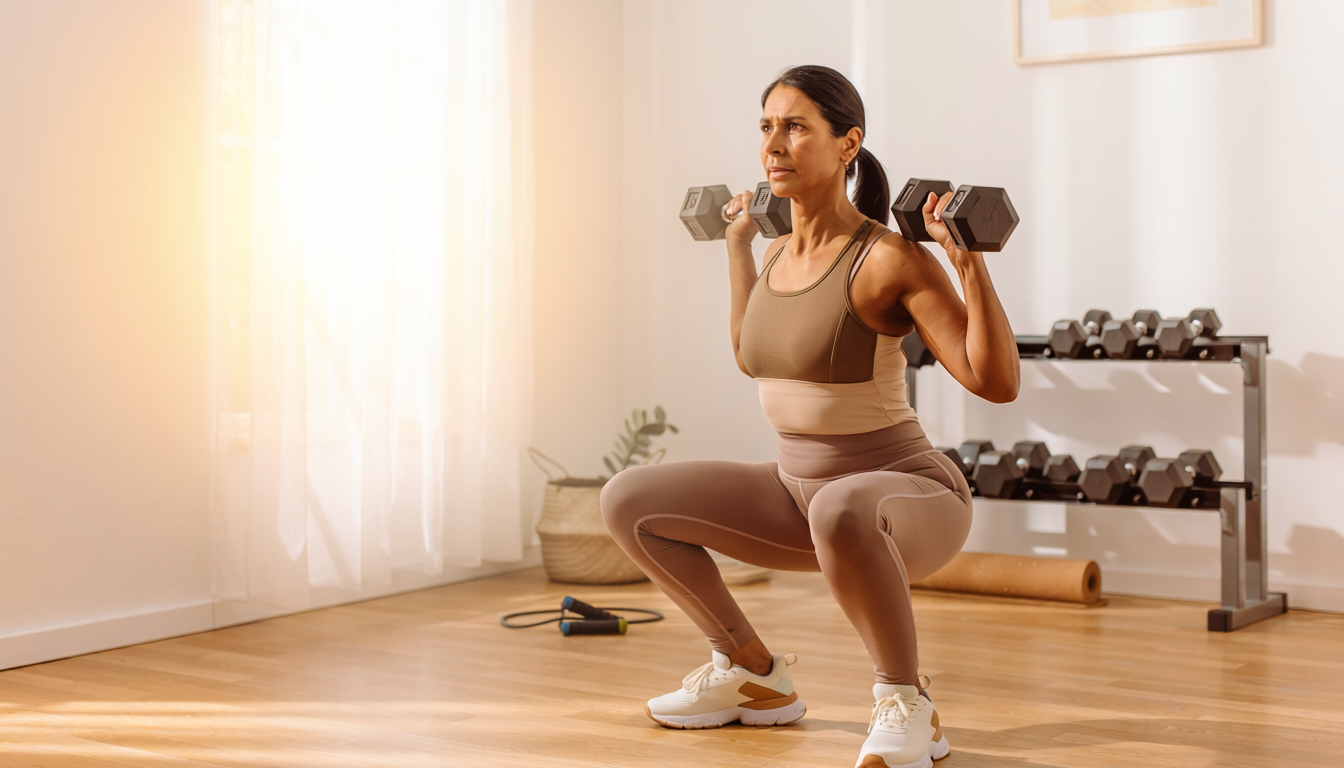
Resistance training builds bone density by loading the bones being worked. When muscles contract against resistance and external weight compresses the skeleton, bone reads that load as a signal to build more mass. Two to three sessions per week of compound movements — squats, deadlifts, presses, carries — maintains and often improves bone density at the hip and spine in women over 40.
By Deb Simpson, NASM Certified Personal Trainer — Deb coaches women over 40 who are building strength from the ground up.
- Do You Actually Need to Worry About Bone Density Yet?
- Why Calcium Alone Doesn’t Build Bone
- What Doesn’t Count as Weight Bearing Exercise for Bone Density
- What Actually Builds Bone Density
- Two Pieces, Working Together
- Frequently Asked Questions
Aging, resistance training, and bone density have a real, direct relationship — and I didn’t know the extent of it until I hit my mid-40s, started perimenopause, and realized how much detail was missing from my understanding of how women’s bodies age.
It’s not that I wasn’t paying attention in 8th grade sex ed: I distinctly remember learning about periods, the parts of the reproductive system, and how babies are made. Learning about whatever mysteries happen after the reproductive years apparently wasn’t the assignment. I still can’t tell whether that’s a systemic feature or a bug, but here we are.
If your experience was anything like mine, commercials for calcium were the full extent of any knowledge of how aging, resistance training, and bone density were related. Nobody explained how, when, why, or whether there’s anything to do about that bone loss. And without the information needed to understand the problem, we can’t implement solutions.
Do You Actually Need to Worry About Bone Density Yet?

Women lose an average of 10% of their bone mineral density during the perimenopausal transition.
Because of this lack of information, for me at least, bone density has been filed under the “older me” task list — something to check once I start getting junk mail from AARP. After all, bone density tests for women don’t typically begin until age 65 – if this were an issue at 50, the medical community would do bone density testing far earlier. Right?
The reality is that research on the musculoskeletal effects of menopause shows that women lose an average of 10% of their bone mineral density during the perimenopausal transition alone — years before any screening guideline requires a bone density test. The beginner strength guide covers the rest of what perimenopause does to muscle and bone, if you want the fuller picture. The CliffsNotes version is that the perimenopause years are the fastest bone-loss window of a woman’s life. That means that the bone density test is just to evaluate the damage, not to try to reduce it.
So, waiting for your doctor to schedule a test isn’t a plan. Neither, as it turns out, is assuming your calcium supplement has this covered.
Why Calcium Alone Doesn’t Build Bone

Your calcium supplement isn’t a waste — it’s the raw material bone is built from, the same way protein is the raw material muscle is built from. But, raw material sitting in your bloodstream doesn’t automatically become bone any more than protein sitting in your stomach automatically becomes muscle (I wish!). Something has to signal your body to enter a building phase and actively replace lost bone.
That something is mechanical load. Bone is living tissue, and it responds the same way muscle does: push it past its normal baseline, and the body reads that as a signal to build more in case you do that again. But when there’s no signal, there’s no demand: calcium without load doesn’t create the conditions necessary for your body to rebuild lost bone mass. Weight bearing exercise is what creates that demand.
What Doesn’t Count as Weight Bearing Exercise for Bone Density


In order to be considered a weight bearing exercise that improves bone density, the exercise has to do two things: stress your skeletal system with enough force and stress it in the right areas. Enough force means clearly above what your body already handles day to day. The right areas are the hip and spine specifically — the two fracture sites tied to the highest mortality and disability once bone loss has progressed.
Swimming and cycling miss on both counts: no meaningful force, and none of it reaches the hip or spine. Yoga, Pilates, barre, and some standard cardio equipment like ellipticals and pedal steppers are weight-bearing at those sites, but the load is still just your bodyweight — not enough force to register as anything above your day-to-day baseline loading.
What Actually Builds Bone Density
Three types of weight bearing exercise reliably build bone density in the perimenopause years: walking, resistance training, and jumping. Walking is the low impact exercise for bone density — repeated ground reaction force at moderate intensity. Jumping is the high impact exercise for bone density — brief, high-force landings that produce the biggest bone-building signal per rep. Resistance training sits outside the impact spectrum: the load comes from what you’re lifting, not from your feet hitting the ground, which means resistance training and bone density work through a different mechanism entirely.
Walking for Bone Density

Here’s how walking builds bone: every stride, your bodyweight travels down through your leg, hip, and spine as your foot hits the ground. Bone reads that repeated ground reaction force as load. If the walk is harder than what your body has adapted to, the signal is loud enough to trigger new bone growth — research on brisk walking in perimenopausal women showed a measurable increase in hip bone density after 48 weeks of consistent brisk walking.
The trick is that it doesn’t count as weight bearing exercise to build bone density until it’s harder than what you’re already doing. Walking around the block at conversational pace does plenty of good things — mood, cardiovascular health, stress management, happy dogs — but it isn’t building bone. Your hip and spine already handle that load every day just standing up.
There are three ways to make walking a weight bearing exercise for bone density: faster, further, or at a higher incline than your current baseline. Faster means picking up the pace to where holding a full conversation gets a little effortful. Further means adding distance to what you already do — an extra loop, an extra block, an extra fifteen minutes. Higher incline means finding hills, using the treadmill’s incline setting, or heading up stairs instead of taking them for granted.
If you’re not walking regularly yet, the beginner walking plan is the starting point — structure and progression already built in.
Resistance Training and Bone Density

Resistance training builds bone through a different mechanism than walking. In walking, the repeated impact of many steps over time is what drives bone regeneration. In resistance training, there are two distinct signals that tell your body to produce bone: muscular contraction and axial compression. When a muscle contracts against resistance, its tendon pulls on the bone it’s attached to, and bone reads that pull as load. That’s called muscular contraction. Axial compression is when you’re standing under an external weight like a barbell, dumbbells, or a loaded backpack and that weight travels straight down through your skeleton, compressing the bones in the line of force. Two loading signals at the same site every rep. And, because resistance training builds muscle at the same time, you’re also building the stability that protects your joints under any kind of load.
The relationship between resistance training and bone density comes down to exercise selection — the exercises you choose determine which bones get loaded, and the ones to load are the hip and spine. Loading those specific sites through resistance training is the direct intervention against fracture risk. Squats, deadlifts, presses, and carries put significant load through the hip and spine, which is why they’re the anchor of a program built for bone density.
But your body adapts fast. The workout that produced results in week three won’t produce the same results in week six, because your bones have caught up to that load, just like your muscles have. That’s when progressive overload enters the picture — the training concept for making the exercise a little harder over time so bone keeps getting the “build more” signal.
Progressive overload runs on more than “add weight.” There are five levers you can adjust: reps (more of them at the same weight), sets (more rounds), rest (less time between sets), tempo (slow the lowering phase), and load (heavier weight). Any one of them, adjusted, tells your body the last version got too easy. If heavy lifting isn’t your goal, or your equipment tops out at 15-pound dumbbells, tempo, reps, and sets can extend the runway before load has to increase — though heavier loads eventually produce the biggest bone-density signal.
If you’ve been out of exercise long enough that a strength routine sounds daunting, but the idea of using weight lifting to increase bone density appeals, take a look at the free 4-week beginner workout plan. Three sessions a week, bodyweight only, movements chosen to help you build the base strength to start loading your bones. Once bodyweight isn’t hard anymore, what to do after beginner strength training picks up.
If you’d rather have someone else build the plan and coach the progressions — walking pace, first resistance sessions, when to add load — that’s what Featherweight Fitness is for. Virtual personal training for women over 40, building strength from the ground up.
Jumping for Bone Density

Jumping is a high impact exercise for bone density — and, if efficiency is your objective, it’s the best exercise to build bone density. Jumping and bone density have a direct relationship: high-force landings trigger new bone growth by generating force well above what your bones typically experience, enough to signal “this is new, build more.” Plyometric box jump landings can peak at 3 to 5 times your bodyweight per landing. For a 150-pound woman, that’s 450 to 750 pounds of force through the leg, hip, and spine in a fraction of a second.
That same force can wreck ankles, knees, and hips that haven’t been getting loaded regularly. That’s why walking and resistance training build the base first: brisk walking teaches your legs to absorb repeated ground reaction force at manageable levels, and resistance training builds the muscle that stabilizes your joints when the force gets greater.
Once brisk walking feels comfortable and you have some strength training under your belt, jump rope is the natural starting point to progress to jumping. It’s the mildest form of impact loading — jump rope for bone density works because it produces enough force to signal new bone while staying below the peaks of true plyometrics.
From jumping rope, using a plyometric box for low-height step-ups and step-offs builds your body’s tolerance for absorbing the landings that real plyometric jumps ask for. Plyometric box jumps are the ceiling for jump training for bone density: high force per rep, controlled landings, done in low volume. Your heart may be ready for plyo jumps on day one. Your ankles, knees, hips, and back will have other opinions.
Starting Where You Are
Picking the right exercise matters less than picking one and starting. Walking works if you’re beginning from very little activity. Resistance training works if you’re ready to load your body more directly. Jumping works if you’ve built the base for it. And you can pick more than one — walking plus resistance training is stronger than either alone.
Get medical clearance if you’re managing something that affects joints, heart, or bones directly. Then pick one thing and do it consistently, because consistency compounds. Whatever plan you actually do beats the perfect plan you never started.
Two Pieces, Working Together

Calcium supplies the material. Load supplies the signal. Together, they build bone.
Calcium supplies the material. Load supplies the signal. Together, they build bone. Walking, resistance training, and jumping deliver that load. Consistency, week after week, is what compounds it into a real result.
If you want a structured plan that handles the progressions — starting weights, when to add load, how to build across all three modalities without guessing — that’s what Featherweight Fitness is for. I coach women building strength from the ground up, including the bone-density piece most beginner programs don’t build around.
Frequently Asked Questions
Does lifting weights help bone density?
Yes. The connection between resistance training and bone density runs through two mechanisms: muscle contractions pulling on bone, and external weight compressing bone through the skeleton. Both signal your body to build more bone at the bones being worked. Two to three sessions per week — built around squats, deadlifts, presses, and carries — is what maintains and often increases bone density in women over 40.
Does walking increase bone density?
Only when it’s harder than what you’re already doing. Walking loads the hip and spine through the force of each step, but if the pace and terrain are the same as your daily baseline, your bones have already adapted and won’t respond. To make walking count as weight bearing exercise for bone density, add pace, distance, or incline that push past your current baseline.
Is jump rope good for bone density?
Yes, and jump rope is often the entry point to jump-based exercise for women over 40. It produces enough force per landing to signal new bone growth while staying below the peak forces of harder plyometric jumps — a lower-impact way to introduce your joints to landing forces before progressing to plyometric box jumps.
What’s the best exercise for bone density?
There isn’t one best exercise. The strongest bone-building signal per rep comes from jumping — landings produce the highest force. But resistance training loads the hip and spine most reliably and requires the least joint preparation to start. For most women over 40, the strongest program combines walking as a base, resistance training as the anchor, and jumping added once the base is built.
How often should I train for bone density?
Two to three sessions of resistance training per week, plus walking on the days you’re not lifting. Bone takes longer to adapt than muscle does, so training more frequently won’t produce faster results. Consistency over months matters more than intensity in any single week.
Can I rebuild bone density that’s already lost?
Yes, and during perimenopause this training has been shown to produce meaningful gains. In one study, perimenopausal women who did 48 weeks of consistent brisk walking increased their hip bone density by 8.23%. Adding resistance training and jump-based exercise can produce additional gains at the hip and spine. Expect gradual improvement over months, not rapid reversal — but the improvement is real.
Do I still need calcium if I’m doing resistance training?
Yes. Resistance training tells your body to build bone, but it can’t build bone without the raw material. Calcium is that raw material. Getting enough calcium combined with training is the combination that works — either one alone is incomplete.
Is exercise safe if I have osteopenia?
Resistance training is safe and encouraged with an osteopenia diagnosis — those movements are exactly what the diagnosis calls for. Jump-based exercise (jump rope, plyometric box jumps) needs more caution — talk to your doctor about how much impact is safe before adding jumping. Osteoporosis is a different case: some movements need to be avoided, and a professionally supervised program is the right starting point.
Keep Exploring
- Not walking regularly yet? Beginner Walking Plan — the accessible entry point for building the base every bone-density program needs.
- Ready to start lifting? Free 4-Week Beginner Workout Plan — bodyweight-only, three sessions a week, movements that translate directly into loading your hip and spine.
- New to strength training entirely? Beginner Strength Guide — the fuller picture on why and how women over 40 should be training, beyond just bone density.