
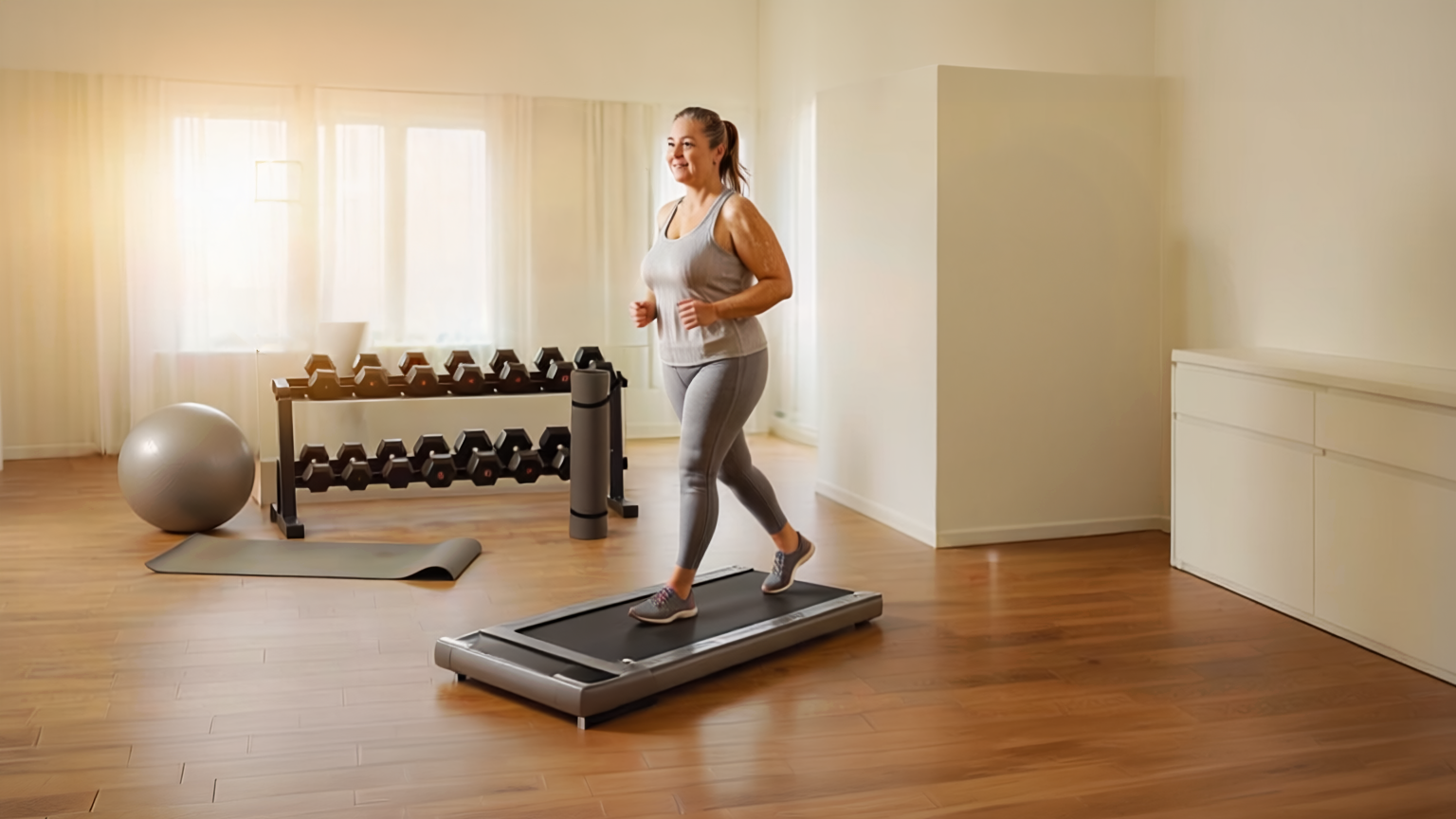
This beginner walking plan builds from 60 minutes in Week 1 to the CDC’s recommended 150 minutes per week by Week 6, spread across three to five sessions weekly. Walk at moderate intensity — you can talk but not sing. Session length increases gradually. No equipment required. Works outdoors, on a treadmill, or on a walking pad.
By Deb Simpson, NASM Certified Personal Trainer — Deb coaches women over 40 who are building strength from the ground up.
- The schedule is the workout
- This doesn’t require a new block of time
- Set a date, then stop checking
- The plan
- What’s next
- Frequently Asked Questions
Walking is not a workout. It’s also not nothing. It’s somewhere in between, which is exactly why it’s a useful starting point if you’ve been sedentary and you’re trying not to stay that way.
The goal of this plan is not to get you in shape in 6 weeks. That’s not how bodies work, and anyone who tells you otherwise is selling something. The goal is to quietly move your baseline upward — the range of activity your body can handle without charging you for it afterward, without your body noticing you’re doing it.
Here’s something nobody warns you about. At some point — the exact age varies but it will happen — your body starts charging a recovery tax on activities that used to be free.
When I was 40, older runners would call me a baby and I thought they were just being dramatic. Until I hit 45, and realized the difference in how fast I recovered was…a lot. And that’s with running and strength training throughout those 5 years. The gap between 40 and 45 is not the same gap as between 30 and 35, and I have found that my body is not particularly interested in my personal opinions about all of this. Sound familiar?
That wall has a name. Physical therapists call the range of activity your body can handle without consequences your envelope of function. Most people find out where theirs is the old-fashioned way: they do too much, pay for it for three days, and stop entirely. This plan does the opposite. Small, consistent increases. Your body adapts. Nobody ends up crashed out on the couch with an ice pack.
If you’d rather have someone build the plan while you focus on showing up and walking, that’s what Featherweight Fitness is for. I work with women over 40 building fitness from the ground up — starting point included.
The schedule is the workout
Think about everything you show up for consistently without it being a decision: work, your kids’ events, aging parents’ appointments, your own doctor visits. Nobody has to convince you to do those things. They’re on the calendar and you go.
This beginner walking plan works the same way. The goal of the first six weeks isn’t really 150 minutes of walking — it’s making the walking days as non-negotiable as Tuesday night pickup. Once the days are automatic, everything else — the minutes, the pace, what you build on top of it — becomes possible. Before that, nothing is.
Consistency beats optimization. Always. The person walking 20 minutes four days a week for a year will lap the person who goes hard for two weeks, disappears for three, and starts over. The schedule is the training. Show up on the right days. That’s it.
This doesn’t require a new block of time
Scheduled walking days doesn’t mean a 5am alarm or rearranging your day around a workout. It means deciding in advance which days you walk, and then figuring out where in those days the walk fits. That part is usually easier than it sounds.
A 30-minute walk is 30 minutes to call someone you’ve been meaning to call. Or guilt-free scrolling, because you’re moving. Or that episode of the show that always felt like too much of a luxury to sit still for. You’re not adding something to your day — you’re converting time that was already going to be spent on something sedentary.
This is also why a walking pad makes sense for a lot of people. Not because it’s better than going outside, but because it makes the conversion frictionless. The show is already on. The pad is already on the floor. The gap between sitting and moving gets very small very fast.
Set a date, then stop checking
Most fitness plans fail the same way: people start evaluating results too early. Three weeks in, nothing looks different — because three weeks isn’t enough time for anything visible to happen — and they decide it isn’t working.
The fix is a specific date. Six weeks out is enough time for real adaptation to happen, and six weeks from now almost always lands near something real on the calendar — back to school, a trip, a holiday, a birthday. That’s not a coincidence, it’s just how the calendar works. Use it.
That date is your checkpoint, not a verdict. When you get there, the only question is: did I hit 150 minutes most weeks? Not whether you look different, not the scale. Those are measurements for a longer timescale. The date is what protects you from a bad Tuesday becoming a reason to scrap the whole thing.
I use the same approach with fat loss: set a date 8 to 12 weeks out and stop staring in the mirror until then. Progress is happening before you can see it. The date is what lets you trust that without having to verify it every 48 hours.
The plan
The 6-week schedule below builds to 150 minutes of moderate-intensity walking per week — the CDC’s baseline recommendation for adult physical activity. It’s designed for people who’ve been sedentary for a while, which means it starts slowly on purpose.
The days are suggestions, not rules. Move rest days around your life as needed. The one constraint: get the week’s sessions in during that week. All-or-nothing thinking kills more plans than anything else — if Monday doesn’t happen, move it to Tuesday. The week isn’t blown.
Moderate intensity means you can talk but not sing. If you can hold a conversation without gasping, you’re in the right zone. If you can deliver a full verse of anything without pausing, pick up the pace. Most people are surprised how much effort a genuine 3.5 mph walking pace actually requires — it’s not a stroll. If you can barely say three words, slow down. At this stage the minutes matter more than the pace.
| Week | Mon | Tue | Wed | Thu | Fri | Sat | Sun | Total |
|---|---|---|---|---|---|---|---|---|
| Week 1 | 20 min | — | 20 min | — | 20 min | — | — | 60 min |
| Week 2 | 20 min | — | 20 min | — | 20 min | — | 15 min | 75 min |
| Week 3 | 20 min | — | 20 min | 15 min | — | 20 min | 20 min | 95 min |
| Week 4 | 25 min | — | 25 min | 20 min | — | 25 min | 20 min | 115 min |
| Week 5 | 30 min | — | 30 min | 25 min | — | 30 min | 25 min | 140 min |
| Week 6 | 20 min | — | 30 min | 30 min | — | 40 min | 30 min | 150 min |
You’ll notice the plan doesn’t hit 150 minutes until Week 6. That’s intentional. The first few weeks aren’t about the minutes — they’re about making the days non-negotiable.
What’s next
After 6 consistent weeks, your envelope of function has moved. The habit exists. The next question is whether you want to maintain this level — which is genuinely worth doing and not a consolation prize — or build on it.
Building on it means faster pace, longer sessions, or adding strength training alongside the walking. Those are the levers. The door is open for that conversation now, and it wasn’t before you started.
If you want help figuring out what to build on this foundation, that’s exactly what I do at Featherweight Fitness. Walking is a starting point. What comes next depends on what you’re actually trying to get to.
Frequently Asked Questions
How many minutes should a beginner walk per day
This plan starts at 20 minutes per session, three days a week. Session length increases gradually over 6 weeks as your body adapts. Total weekly minutes matter more than any single session length.
How do I know if I’m walking at the right intensity?
Use the talk test. You should be able to hold a conversation without gasping. If you can sing comfortably, pick up the pace. If you can barely get three words out, slow down.
Can I move the rest days around?
Yes. The days in the plan are a sample schedule. The one rule is to complete that week’s sessions within the same week. Don’t let a missed Monday become a reason to skip the whole week.
How long before I see results from walking?
Physical adaptation starts immediately but isn’t visible for several weeks. Set a 6-week checkpoint date before you start and don’t evaluate results until you reach it.
What comes after the 6-week plan?
Options are maintaining 150 minutes per week, increasing pace or session length, or adding strength training alongside the walking. The plan builds the foundation — what you build on it depends on your goals.
Do I need a treadmill or walking pad to follow this plan?
No. The plan works outdoors, on a treadmill, or on a walking pad. A walking pad makes it easier to convert existing sedentary time into active time, but it isn’t required.
Keep Exploring
- Walking Pads: What They Are, What They Do, and Whether One Makes Sense for You: If you’re going to walk indoors, this is worth reading before you buy anything.
- Best Walking Pads for Beginners: When you’re ready to pick a pad, this is the buying guide.
- Beginner Workout for Women Over 40: If strength training is the next lever, this is where to start. Bodyweight only, no equipment required.