
By Deb Simpson, NASM Certified Personal Trainer — Deb coaches women over 40 who are building strength from the ground up.
- Walking pad vs. treadmill
- What a walking pad actually does
- Is a walking pad worth it?
- What to decide before buying
- Frequently asked questions
A walking pad solves one specific problem, and it’s a problem most fitness content doesn’t name directly: time. Most of the women I know aren’t short on motivation — they’re short on options that fit the hours that are actually theirs. A walking pad changes what you’re doing during the hours you’ve already got, which is what makes it worth it when the schedule itself won’t move.
For most women closing in on 50, the day has a certain rhythm: full court press to get everyone to their respective schools or offices, then a job where “other duties as assigned” is apparently the whole job description. Lunch eaten at your desk, breaks skipped, and then the commute home. Somewhere in there, the school texted about something, the dog is due for a vet appointment nobody has scheduled, and you’re mentally running the grocery list for a dinner you just started thinking about and it’s already 4pm.
By the time the day is technically done, you’re not tired from sitting. You’re tired from deciding. Every small response you’ve made in the last twelve hours has been a choice and none of them were the interesting kind. That’s mentally exhausting, and for a lot of us the couch and our phone or the TV is the first place all day where we’re not having to answer the constant barrage of small choices that make up our daily lives. The show is on because it doesn’t require you to think. The phone is a hit of something that isn’t work and isn’t a kid or partner needing something from you. Sound familiar?
None of this is new. Humans have always ended the day by finding something low-stakes to occupy the brain — sitting around a fire, telling the same stories, hands busy with weaving, carving, or mending. What’s new is that the rest of the day used to include a lot of activity just to have food, shelter, and warmth. Hunting, gathering, hauling water, getting from one place to another on foot. The wind-down was the reward for a body that had already moved.
Modern life doesn’t work that way — we sit, and then the wind-down to sitting is more sitting. The body never gets the work it needs. A walking pad puts that work back in without asking you to give up the wind-down to do it.
Walking pad vs. treadmill
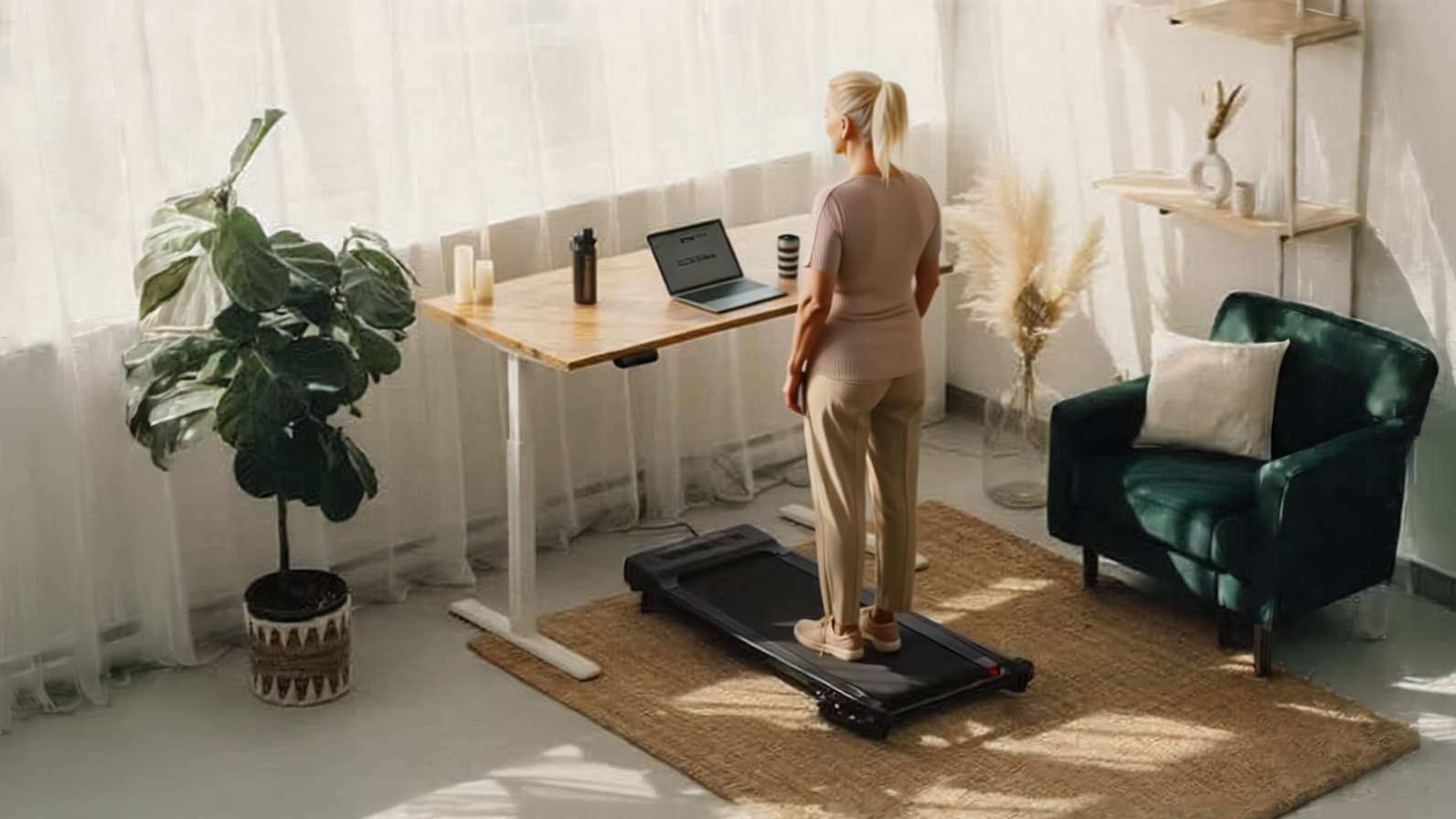
A walking pad and a treadmill are built for different jobs. A walking pad is a stripped-down base with a motor built for walking speeds, not running. Most models don’t have handrails, a display screen, or a cupholder — nothing resembling the console-and-frame structure that makes a standard treadmill the size of a small car. What’s left is a flat moving belt, a motor, and a remote or app to adjust speed.
The practical differences come down to three things: footprint, cost, and maximum speed.
A standard treadmill needs a substantial footprint — 6 to 7 feet extended, plus clearance on all sides. A walking pad stores flat under furniture, and most models have wheels, so moving it out of the way doesn’t require advance planning or another person. Cost-wise, a decent treadmill starts around $800. Walking pads run $100 to $450 for models worth owning. You’re paying for a smaller motor and a simpler frame, neither of which matters if the idea of running without being actively chased is a foreign concept.
Where walking pads lose: they top out at 3 to 5 mph and aren’t built for running. If running is the plan, this is the wrong machine. Get a treadmill.
What a walking pad actually does
A walking pad puts daily walking back into a life that stopped including it by default. Humans evolved to walk — our bodies are, structurally speaking, built around it. And yet walking is now a category of exercise equipment sold in a box; the day got too full to do the thing the body was designed to do by default. A walking pad does two things at the same time: it lets you get a walk in, and it lets you do it on hours you were already spending sitting.
A lunch break walked instead of sat at your desk. A phone call taken on your feet. A show watched on the walking pad in the evening. Accumulated across a day, that’s around 45 minutes of walking — roughly 2 miles. For a sedentary starting point, that’s more than double the walking you’re doing now.
Over weeks, that shift moves your daily step count from a sedentary baseline into the 8,000-plus range that research links to lower mortality risk. Sleep gets better first, usually within days. Afternoon energy steadies out inside a couple of weeks — the crash that used to hit around 3pm gets shallower. Stairs and getting up from the couch get easier, because the hip and glute strength both of those depend on is being used every day.
Is a walking pad worth it?
The answer depends on what you want the walking pad to do, and the three most common questions have three different answers.
For hitting daily movement inside a schedule that no longer has a workout window in it — yes. This is the job the walking pad is built for, and consistent use is what makes it work.
For weight loss — yes, because walking burns calories and calories out is half of the weight loss equation. A walking pad lets you accumulate structured cardio during hours you were spending sitting anyway. The catch is volume. Ten minutes here and there isn’t going to move the number. Real accumulated volume via a structured walking plan, plus handling the food side, is what does. The 6-Week Beginner Walking Plan is built for exactly that.
For replacing strength training — no. If you’re already doing strength, adding walking is good. If you’re doing nothing right now, walking is better than nothing and a walking pad makes it possible. If you can find the time for strength training, strength beats walking for what your body needs most through perimenopause and menopause — muscle and bone density that decline steeply without it. The beginner strength guide covers where to start on the strength side when the time opens up.
If you’d rather have someone else build the walking volume and the food side into a plan that fits your life, that’s what Featherweight Fitness is for. I work with women over 40 doing virtual and in-home personal training — walking, strength, and nutrition built around the life you actually have.
What to decide before buying
Before you get to model comparisons, three decisions will shape which walking pad makes sense for your setup: weight capacity, whether it has a handle, and whether it inclines.
Walking pad weight limit. Most standard walking pads cap at 220 to 265 pounds. Near or above that range, the frame and motor will wear faster than they should under regular use. The walking pad buying guide covers high weight capacity walking pads specifically — worth reading before you decide the category isn’t for you.
Handle or no handle. Walking pads come in two configurations. No-handle models are the simplest — flat, low profile, designed to slide under a standing desk. Foldable-handle models (sometimes marketed as “2-in-1”) work as a walking pad with the handle folded down, and as a proper treadmill with the handle raised, which unlocks running speeds. If you’re only going to walk, a no-handle model is cheaper and takes less space. If you want the option to run without buying a second machine later, a foldable-handle model gets you both jobs in one purchase.
Incline. Most walking pads are flat. The ones with incline add cost and mechanical complexity, but they also let you increase intensity without increasing speed — useful if you’re using the walking pad for dedicated walking sessions rather than background movement during shows or calls. Not a first-purchase requirement, but worth deciding before you buy so you’re not looking at an upgrade six months later.
For model comparisons, current prices, and specific picks at each price point, the walking pad buying guide covers all of that.
A walking pad isn’t a workout, and it isn’t going to change the reality of a schedule that eats most of your day. What it does is let you spend the same time with your phone or a show — with the walking your body needs to stay healthy thrown in.
If you want the rest of the picture built around that same reality — strength training, walking volume, and the food side — that’s what Featherweight Fitness is for. I work with women over 40 doing virtual and in-home personal training, built around the life you actually have.
Frequently asked questions
Can you run on a walking pad?
Not on a standard walking pad. Walking-only models top out at 3.5 to 3.8 mph, which is a brisk walk, not a run. Foldable-handle “2-in-1” models unlock running speeds when the handle is raised — those work as a proper treadmill for running and as a walking pad with the handle folded down. If running matters to you, buy the 2-in-1 or buy a treadmill. A walking-only pad isn’t going to get there.
Is a walking pad worth it?
For daily movement inside a schedule that doesn’t have room for a separate workout — yes. It converts hours you were already spending sitting into accumulated walking, without requiring you to add anything to your calendar. It won’t replace strength training, and it won’t produce weight loss on its own. But it will move your daily step count from a sedentary baseline into the range research links to better health outcomes, and that’s a meaningful shift.
Can you put a walking pad on carpet?
Yes, but with two caveats. Low-pile carpet is fine. High-pile or thick carpet can trap heat under the motor and shorten its lifespan — use a low-pile rug pad or a treadmill mat underneath if that’s your setup. Second, carpet can absorb some of the belt’s vibration, which makes the walking pad feel slightly less stable. A mat solves both problems for around $30.
Does a walking pad help you lose weight?
Yes, as part of a calorie deficit. Walking burns calories, and calories out is half of the weight loss equation. A walking pad makes it easier to accumulate enough walking volume to matter, because you can add movement to hours you were already spending sitting. Ten minutes here and there isn’t going to move the number. Real accumulated volume plus handling the food side is what does.
What’s the weight limit on a walking pad?
Most standard walking pads cap at 220 to 265 pounds. Above that, the frame and motor wear faster than they should under regular use. Higher-capacity models exist and are covered in the walking pad buying guide.
Keep Exploring
- Walking Pad Buying Guide — Model comparisons and current picks, including high weight capacity walking pads
- 6-Week Beginner Walking Plan — A structured walking plan for wherever you’re starting from
- Beginner Strength Guide — Where to start on the strength side when time opens up